


info@kps.com.vn
+84 903 709 019
In the last five years, the rise of AI (Artificial Intelligence) has reshaped the entire technology landscape. From machine learning, large language models like GPT, to autonomous robots—AI is penetrating almost every industry. At the same time, blockchain has emerged as a breakthrough technology, not only powering cryptocurrencies but also enabling transparent, decentralized, and tamper-proof systems.
When these two technologies converge, they create a perfect combination: AI makes blockchain smarter, while blockchain makes AI more transparent and trustworthy. In this article, we’ll dive into Blockchain, AI, and the relationship between them in today’s digital era.
Blockchain is a distributed ledger. Instead of storing data on a central server (like banks or Facebook), blockchain stores information across thousands of computers in a network. This gives blockchain three extremely important characteristics:
No single party owns the blockchain.
No government can delete the data.
No company can modify transaction history at will.
Once data is recorded on the blockchain, it is nearly impossible to change or delete.
Every transaction can be publicly verified with 100% transparency.
Example:
If Facebook used blockchain, they couldn’t delete your posts or manipulate your follower count.
If banks used blockchain, they couldn’t secretly change account balances.
This makes blockchain extremely important in the age of AI, where the line between truth and falsehood is becoming increasingly blurred.

While AI is rapidly evolving and making life easier, it also introduces several challenges that the world has yet to solve.
AI is only as good as the data it learns from. In reality, AI can make mistakes when trained on:
Missing data
Incorrect or manipulated data
Biased data
In fields like healthcare, finance, or law, wrong decisions can be extremely dangerous.
Modern AI models—especially deep learning—are powerful but complex, making their decision-making process difficult to understand or explain.
Because of this:
Businesses hesitate to deploy AI in critical systems
Users may not trust results they cannot interpret
This lack of explainability is a major barrier.
AI-generated images and videos are increasingly realistic. Criminals now use deepfakes to impersonate police officers, CEOs, or public figures, causing major financial losses.
There have even been cases where a deepfake CEO caused a company to lose millions of dollars.
AI systems collect and analyze massive amounts of personal data:
Usage habits
Browsing history
Facial recognition
Voice patterns
Location data
Social media behavior
While this makes AI smarter, it also increases risks such as data theft, unauthorized access, and loss of control over one’s personal information.
Blockchain is becoming a critical technology for addressing AI’s weaknesses—especially transparency, verifiability, and trustworthiness. Thanks to its immutable and traceable nature, blockchain enhances AI in several ways.
Storing training data on the blockchain means:
It cannot be deleted or altered
Any update creates a new entry, maintaining a complete history
This ensures data provenance, reducing risks of AI learning from corrupted data.
Blockchain can log:
Input data
AI outputs
Key model parameters
Processing logic
This creates an audit trail, allowing users and regulators to understand why an AI made a specific decision. AI becomes explainable, not a mysterious “black box.”
If all AI results are recorded on blockchain:
No one can modify or falsify outcomes
Responsibility cannot be evaded
Fraud becomes nearly impossible
This is essential in industries requiring accuracy such as finance, insurance, healthcare, and law.
Blockchain enables a future where users can:
Know exactly who is accessing their data
Approve or deny access
Revoke permissions at any time
This protects privacy while supporting responsible AI usage.
With blockchain, every part of the AI lifecycle becomes verifiable:
Data
Model
Output
Changes
AI evolves from an opaque system to a fully traceable and trustworthy one.
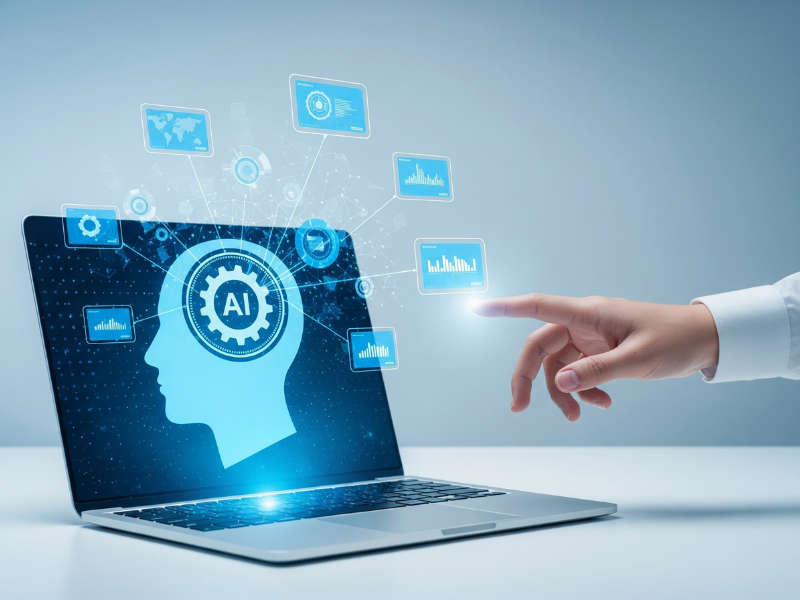
The relationship goes both ways. If blockchain strengthens AI with transparency and verification, AI enhances blockchain with intelligence, security, and operational efficiency.
AI analyzes network activity in real time to:
Predict congestion
Adjust operations automatically
Reduce gas fees
Speed up block processing
This makes blockchain faster, cheaper, and more scalable.
Smart contracts are powerful but hard to write and easy to break. AI can:
Auto-generate code
Detect vulnerabilities
Review logic
Suggest fixes
This makes Web3 development safer and more efficient.
Even decentralized networks can be attacked. AI helps monitor transactions for:
Unusual behavior
Hacks
Money laundering
DeFi exploits
Some platforms already use AI-powered monitoring to protect users.
Starting from 2025, the fusion of AI and blockchain will create a new technological ecosystem—transparent, verifiable, decentralized, and collectively owned.
Here are the trends that will dominate the next decade:
AI will no longer be monopolized by Google, Meta, or OpenAI.
Instead, models will run on decentralized networks where anyone can contribute computing power and earn rewards.
Projects like Bittensor, SingularityNET, Fetch.ai, Ocean Protocol are leading this movement.
To fight deepfakes:
Blockchain records content source and timestamp
AI identifies human-made, AI-made, or modified content
This is crucial for journalism, politics, education, and security.
AI analyzes skills, reputation, and behavior, while blockchain ensures authenticity.
These smart profiles can support:
Recruitment
Credit scoring
Community access
Verification tasks
AI processes IoT data, while blockchain ensures integrity.
Applications include:
Traffic systems
Public safety
Infrastructure monitoring
AI personalizes learning, while blockchain stores:
Certificates
Achievements
Lifelong learning records
All tamper-proof and globally verifiable.
AI assists with diagnosis and treatment recommendations, while blockchain stores medical records securely and consistently across all hospitals.
AI analyzes product quality, blockchain records product journey:
Agriculture
Food safety
Pharmaceuticals
Luxury goods
Helping eliminate fraud and counterfeits.
AI predicts markets, optimizes strategies.
Blockchain automates:
Trading
Payments
Staking
This could be the second wave of fintech—smarter, transparent, and less dependent on humans.
Other news

Signify and KPS sign strategic partnership agreement.
Signify and KPS have signed a strategic partnership to promote smart, energy-efficient lighting solutions for buildings in Vietnam.
View detail

From APEC 2017 Da Nang to APEC 2027 Phu Quoc: From traditional security solutions to smart IOCs.
From APEC 2017 security monitoring solutions to a smart IOC model for APEC 2027 in Phu Quoc.
View detail

Team Building KPS 2026 | Da Nang - Hoi An - Hue
KPS 2026 Team Building journey in Da Nang - Hoi An - Hue, where teams bond, recharge, and spread sustainable values.
View detail

Optimizing air conditioning based on room conditions in hotels and resorts.
Why do 20-30% of hotel rooms still have their air conditioning running even when there are no guests?
View detail

Energy-saving solutions for hotels and resorts - without compromising the experience.
Consulting and implementing EMS systems for hotels - reducing electricity costs, smarter operation - without compromising customer experience.
View detail

Energy Management System (EMS): Cost and Operation Optimization
EMS solutions help businesses monitor, analyze, and optimize energy in real time, saving 10-30% on electricity costs.
View detail
ABOUT KPS


Regulations and policies
Warranty and return policy Delivery, payment, and feedback Giấy phép kinh doanhContact Information
HO CHI MINH OFFICE
10–12 Dong Van Cong Street, Cat Lai Ward, Ho Chi Minh City.
+842839976099 / 903 709 019
info@kps.com.vn
www.kps.com.vn
Work time
Monday – Friday : 8:00 AM - 17:30 PM
Saturday - Sunday: Off
HA NOI OFFICE
22 Alley 168 Nguyen Xien, Khuong Dinh Ward, Hanoi City
+84 903 709 019
kpshn@kps.com.vn
www.kps.com.vn
Work time
Monday – Friday: 8:00 AM - 17:30 PM
Saturday - Sunday: Off
DA NANG OFFICE
490 Nguyen Tri Phuong, Hoa Cuong Ward, Da Nang City
+84 903 709 019
kpsdn@kps.com.vn
www.kps.com.vn
Work time
Monday – Friday: 8:00 AM - 17:30 PM
Saturday - Sunday: Off
CAN THO OFFICE
11/11 Tran Binh Trong, Ninh Kieu Ward, Ninh Kieu District, Can Tho City.
+84 090 709 019
kpsct@kps.com.vn
www.kps.com.vn
Work time
Monday – Friday: 8:00 AM - 17:30 PM
Saturday - Sunday: Off
SERVICE CENTER - WAREHOUSE
10–12 Dong Van Cong Street, Cat Lai Ward, Ho Chi Minh City.
+ 84 28 3997 0609
baohanh@kps.com.vn
www.kps.com.vn
Work time
Monday – Friday: 8:00 AM - 17:30 PM
Saturday - Sunday: Off
2010 © Bản quyền thuộc KPS
Online: 28 | Visitors Counter: 17747124
About | Recruitment | News | Contact Us


.png)


