


info@kps.com.vn
+84 903 709 019
Trong các tòa nhà hiện đại - từ căn hộ, khách sạn, bệnh viện đến nhà máy - HVAC là hệ thống đóng vai trò “xương sống” trong việc đảm bảo môi trường sống và làm việc an toàn, tiện nghi và đạt chuẩn kỹ thuật. HVAC không đơn thuần chỉ là “máy lạnh”. Đây là một hệ thống kỹ thuật tổng hợp, kiểm soát đồng thời: Nhiệt độ, độ ẩm, lưu lượng gió và chất lượng không khí.
Bài viết này cung cấp tổng quan toàn diện về hệ thống HVAC, giúp chủ đầu tư, kỹ sư, nhà thầu và người sử dụng hiểu rõ bản chất, cấu tạo, nguyên lý hoạt động của hệ thống.
HVAC (Heating, Ventilation, Air Conditioning) là hệ thống tích hợp sưởi ấm, thông gió và điều hòa không khí. Hệ thống này điều chỉnh nhiệt độ, độ ẩm và chất lượng không khí trong nhà để đảm bảo tiện nghi và sức khỏe cho người sử dụng. Cụ thể, các chức năng cốt lõi bao gồm:
Các chức năng này giúp duy trì nhiệt độ thoải mái quanh mức cài đặt và loại bỏ tạp chất trong không khí, nâng cao chất lượng không khí trong nhà.
Hệ thống HVAC gồm nhiều bộ phận cơ bản phối hợp với nhau:
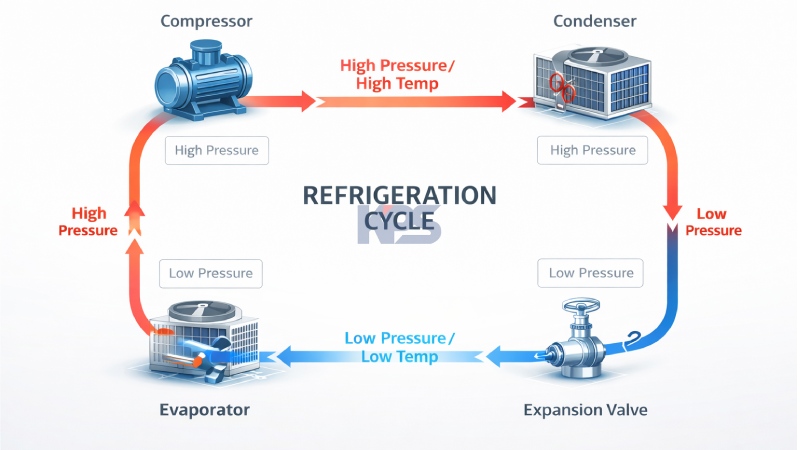
Nguyên lý hoạt động của HVAC là dựa vào chu trình nhiệt-lạnh (refrigeration cycle) và điều khiển tự động để cân bằng nhiệt độ và độ ẩm. Trong chế độ làm mát, máy nén nén môi chất lạnh ở áp suất cao (nhiệt độ cao), sau đó môi chất này đi qua dàn ngưng tụ để tỏa nhiệt ra ngoài môi trường. Tiếp theo, van tiết lưu giảm áp suất môi chất và đưa đến dàn bay hơi; tại đây môi chất hấp thụ nhiệt từ không khí trong nhà, làm mát và ngưng tụ thành chất lỏng trở lại máy nén.
Ngược lại, khi sưởi, hệ thống tạo ra và phân phối nhiệt vào trong không gian sống.
Hệ thống Split là hệ điều hòa gồm:
Hai bộ phận kết nối với nhau qua đường ống môi chất lạnh.
Cấu tạo chính của hệ thống bao gồm:
Loại này phổ biến trong hộ gia đình và căn hộ; trong mùa lạnh thường kết hợp lắp đặt thêm lò hơi (furnace) hoặc máy bơm nhiệt để sưởi.
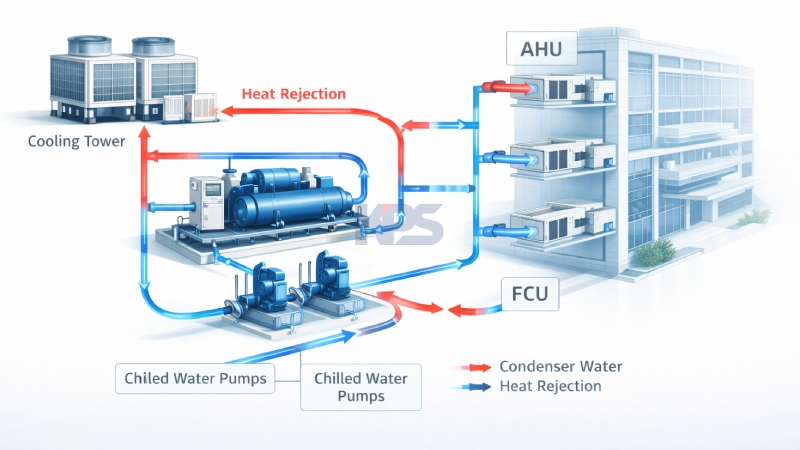
Hệ Chiller sử dụng máy làm lạnh trung tâm để tạo: Nước lạnh hoặc dung dịch tải lạnh, sau đó bơm đến các AHU/FCU trong tòa nhà.
Thành phần hệ Chiller bao gồm:
Hệ chiller phù hợp cho toà nhà lớn, trung tâm thương mại, nhà máy hoặc khu công nghiệp.
VRF (Variable Refrigerant Flow) / VRV (Variable Refrigerant Volume) là hệ thống điều hòa đa vùng:
Nguyên lý hoạt động
Hệ thống phù hợp với các mô hình khách sạn, văn phòng, chung cư cao cấp, trường học...
Trong các công trình hiện đại – từ cao ốc văn phòng, trung tâm thương mại đến bệnh viện và nhà máy - HVAC không còn là hệ thống phụ trợ, mà là hạ tầng kỹ thuật cốt lõi quyết định hiệu suất vận hành, an toàn và giá trị tài sản của tòa nhà.
HVAC hiện đại giúp:
Trong các hệ VRF hoặc Chiller, việc kiểm soát tải phần (part-load) là yếu tố quyết định sự ổn định nhiệt.
Trong tòa nhà hiện đại, chất lượng không khí trong nhà (IAQ) là yếu tố ảnh hưởng trực tiếp đến sức khỏe, hiệu suất làm việc và giá trị vận hành công trình. HVAC đóng vai trò trung tâm trong việc kiểm soát, lọc và duy trì môi trường không khí an toàn.
Theo khuyến nghị của ASHRAE (ASHRAE 62.1), hệ thống thông gió phải đảm bảo lưu lượng gió tươi tối thiểu nhằm duy trì môi trường trong nhà lành mạnh.
HVAC chiếm từ 40-60% tổng điện năng tiêu thụ. Vì vậy, tối ưu hệ thống HVAC chính là chìa khóa để giảm OPEX (Operational Expenditure) và nâng cao hiệu quả đầu tư dài hạn.
Theo tiêu chuẩn của ASHRAE (ASHRAE 90.1), thiết kế HVAC bắt buộc phải đáp ứng yêu cầu hiệu suất năng lượng tối thiểu.
Trong các tòa nhà cao tầng và công trình công cộng, khói mới là nguyên nhân gây tử vong chính khi xảy ra cháy, không phải lửa. Vì vậy, hệ HVAC hiện đại phải tích hợp giải pháp kiểm soát khói - điều áp - ngăn cháy lan theo đúng quy chuẩn.
HVAC tham gia trực tiếp vào:
HVAC không chỉ làm mát hay thông gió mà còn là trung tâm dữ liệu vận hành. Khi tích hợp với hệ thống quản lý tòa nhà, HVAC trở thành nền tảng của mô hình Smart Building.
HVAC kết nối với BMS giúp:
BMS cho phép điều khiển tập trung toàn bộ hệ thống từ một phòng điều khiển.
Chất lượng hệ thống HVAC không chỉ ảnh hưởng vận hành mà còn tác động trực tiếp đến giá trị tài sản và vị thế thương hiệu của chủ đầu tư.
Nâng cao giá trị tài sản:
Hệ HVAC hiện đại mang lại:
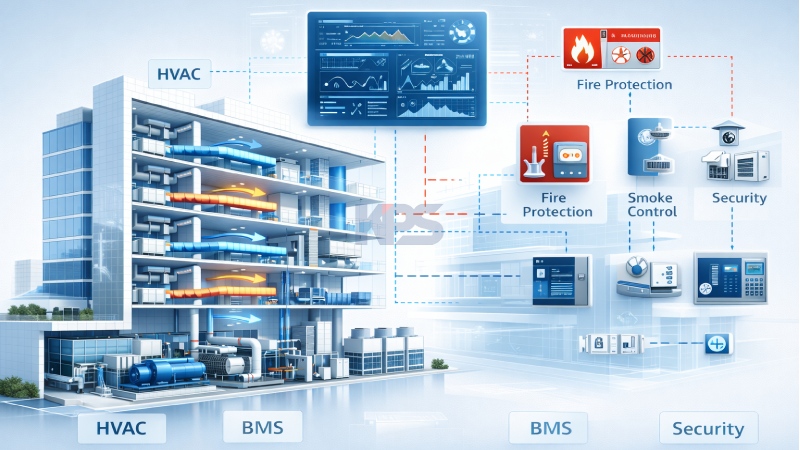
Với kinh nghiệm triển khai hệ thống hạ tầng kỹ thuật tòa nhà từ năm 2010, Công ty Cổ phần Hệ thống An ninh Khai Phát (KPS) cung cấp các giải pháp tích hợp HVAC trong hệ sinh thái quản lý tòa nhà thông minh. Thay vì triển khai HVAC như một hệ thống độc lập, KPS hướng đến mô hình tích hợp toàn diện, nơi HVAC được kết nối với các hệ thống quan trọng như báo cháy, an ninh, kiểm soát ra vào, âm thanh thông báo và hệ thống quản lý tòa nhà (BMS/iBMS).
Thông qua mạng lưới đối tác công nghệ hàng đầu như Johnson Controls, Legrand, Bosch, ABB, Simplex hay GST..., KPS có khả năng triển khai các giải pháp điều khiển và giám sát HVAC ở quy mô lớn, từ tòa nhà văn phòng, khách sạn đến bệnh viện, trung tâm dữ liệu và khu công nghiệp. Các nền tảng quản lý tòa nhà hiện đại cho phép thu thập dữ liệu từ cảm biến, hệ thống điều hòa, thiết bị an ninh và hệ thống năng lượng để tối ưu vận hành, giảm tiêu thụ điện và nâng cao độ an toàn cho công trình.
Nhờ cách tiếp cận tích hợp hệ thống, KPS không chỉ cung cấp thiết bị mà còn mang đến những giải pháp hạ tầng thông minh giúp các tòa nhà vận hành hiệu quả, tiết kiệm năng lượng và đáp ứng các tiêu chuẩn kỹ thuật quốc tế.
Liên hệ KPS ngay để nhận tư vấn kỹ thuật và giải pháp tối ưu cho dự án của bạn.

Các tin khác

Signify và KPS ký kết hợp tác chiến lược
Signify và KPS ký kết hợp tác chiến lược, thúc đẩy giải pháp chiếu sáng thông minh, tiết kiệm năng lượng cho tòa nhà tại Việt Nam.
Xem chi tiết

Từ APEC 2017 Đà Nẵng đến APEC 2027 Phú Quốc: Giải pháp an ninh truyền thống sang IOC thông minh
Giải pháp giám sát an ninh APEC 2017 đến mô hình IOC thông minh cho APEC 2027 tại Phú Quốc.
Xem chi tiết

Team Building KPS 2026 | Đà Nẵng - Hội An - Huế
Hành trình Team Building KPS 2026 tại Đà Nẵng - Hội An - Huế, nơi gắn kết đội ngũ, tái tạo năng lượng và lan tỏa giá trị bền vững.
Xem chi tiết

5 sai lầm vận hành MEP khiến tòa nhà tốn điện mỗi ngày
5 sai lầm vận hành MEP phổ biến khiến tòa nhà lãng phí điện mỗi ngày. Phân tích nguyên nhân và cách tối ưu HVAC, BMS, EMS theo tải thực tế.
Xem chi tiết

Tối ưu điều hòa theo trạng thái phòng trong khách sạn & resort
Vì sao 20-30% phòng khách sạn vẫn chạy điều hòa dù không có khách?
Xem chi tiết

Giải pháp tiết kiệm điện cho khách sạn & resort - nhưng không ảnh hưởng trải nghiệm
Tư vấn & triển khai hệ thống EMS cho khách sạn - giảm chi phí điện, vận hành thông minh hơn - nhưng không ảnh hưởng đến trải nghiệm khách..
Xem chi tiết

Hệ thống quản lý năng lượng EMS: Tối ưu chi phí & vận hành
Giải pháp EMS giúp doanh nghiệp kiểm soát, phân tích và tối ưu năng lượng theo thời gian thực, tiết kiệm 10-30% chi phí điện.
Xem chi tiết

Thiết bị kiểm soát chất lượng không khí AHU
Khám phá vai trò của AHU trong HVAC, từ xử lý không khí, lọc HEPA đến kiểm soát IAQ cho tòa nhà và nhà máy.
Xem chi tiết
GIỚI THIỆU VỀ KPS


Quy định & Chính sách
Chính sách bảo hành, đổi trả Giao hàng, thanh toán và góp ý Giấy phép kinh doanhThông Tin Liên hệ
VĂN PHÒNG HỒ CHÍ MINH
10 – 12 Đồng Văn Cống, Phường Cát Lái, TP. HCM.
+842839976099 / 903 709 019
info@kps.com.vn
www.kps.com.vn
Giờ làm việc
Thứ Hai – Thứ Sáu: 8:00 SA - 17:30 CH
Thứ Bảy - Chủ Nhật: Ngày nghỉ
VĂN PHÒNG HÀ NỘI
22 Ngõ 168 Nguyễn Xiển, Phường Khương Đình, TP Hà Nội
+84 903 709 019
kpshn@kps.com.vn
www.kps.com.vn
Giờ làm việc
Thứ Hai – Thứ Sáu: 8:00 SA - 17:30 CH
Thứ Bảy - Chủ Nhật: Ngày nghỉ
VĂN PHÒNG ĐÀ NẴNG
490 Nguyễn Tri Phương, Phường Hòa Cường, TP Đà Nẵng
+84 903 709 019
kpsdn@kps.com.vn
www.kps.com.vn
Giờ làm việc
Thứ Hai – Thứ Sáu: 8:00 SA - 17:30 CH
Thứ Bảy - Chủ Nhật: Ngày nghỉ
VĂN PHÒNG CẦN THƠ
11/11 Trần Bình Trọng, Phường Ninh Kiều, Quận Ninh Kiều, TP Cần Thơ.
+84 090 709 019
kpsct@kps.com.vn
www.kps.com.vn
Giờ làm việc
Thứ Hai – Thứ Sáu: 8:00 SA - 17:30 CH
Thứ Bảy - Chủ Nhật: Ngày nghỉ
TRUNG TÂM BẢO HÀNH - KHO HÀNG
10 – 12 Đồng Văn Cống, Phường Cát Lái, TP. HCM.
+ 84 28 3997 0609
baohanh@kps.com.vn
www.kps.com.vn
Giờ làm việc
Thứ Hai – Thứ Sáu: 8:00 SA - 17:30 CH
Thứ Bảy - Chủ Nhật: Ngày nghỉ
2010 © Bản quyền thuộc KPS
Đang Online: 64 | Tổng Truy Cập: 18110579
Giới Thiệu | Tuyển dụng | Tin tức | Liên Hệ


