


info@kps.com.vn
+84 903 709 019
In modern buildings—from apartments and hotels to hospitals and industrial facilities—HVAC is the system that acts as the “backbone” in ensuring a safe, comfortable, and technically compliant indoor environment. HVAC is not simply an “air conditioner.” It is an integrated engineering system that simultaneously controls:
This article provides a comprehensive overview of HVAC systems, helping investors, engineers, contractors, and building users better understand the system’s nature, structure, and operating principles.
HVAC (Heating, Ventilation, Air Conditioning) is an integrated system responsible for heating, ventilation, and air conditioning. The system regulates temperature, humidity, and indoor air quality to ensure comfort and health for occupants.
Specifically, the core functions include:
Heating: Provides warmth during cold seasons using furnaces, boilers, or heat pumps. The heating system generates thermal energy (via gas furnaces, boilers, or heat pumps) and distributes it throughout the building via ductwork or heat distribution systems.
Ventilation: Ensures air exchange and circulation of fresh air by supplying outdoor air and removing odors, excess moisture, and contaminants. Fans and duct systems maintain continuous airflow, improving indoor air quality.
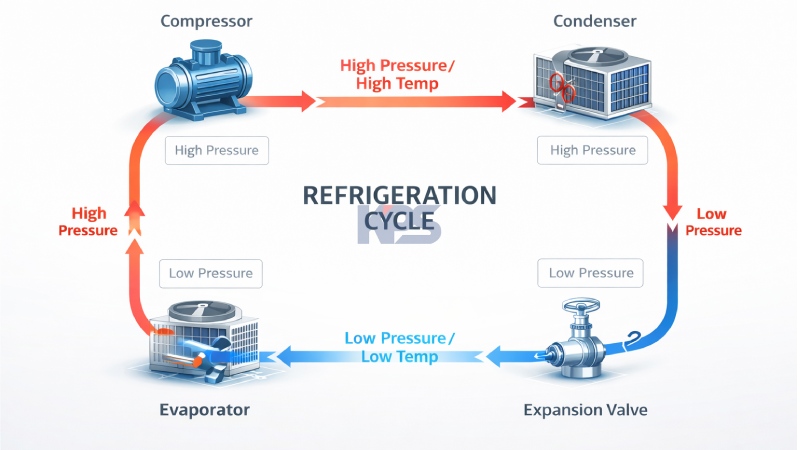
Air Conditioning: Cools indoor spaces and controls humidity during hot seasons. Air conditioning systems operate based on the refrigeration cycle (compressor – condenser – expansion valve – evaporator) to absorb heat and moisture from indoor air and release it outdoors.
These functions maintain comfortable indoor temperatures while removing airborne contaminants and improving indoor air quality.
An HVAC system consists of multiple components working together:
Increases the pressure and temperature of the refrigerant and acts as the “heart” of the refrigeration cycle.
Cools and condenses refrigerant from gas to liquid form while releasing heat to the outdoor environment.
Absorbs heat from indoor air, allowing the refrigerant to evaporate and cool the air.
Reduces refrigerant pressure before it enters the evaporator and controls refrigerant flow.
A network of air ducts that distributes conditioned air (cooled or heated) to rooms and returns stale air back to the system.
The thermostat allows users to set the desired temperature, and the system automatically switches between heating, cooling, or air circulation based on the signal.
Humidity sensors, CO₂ sensors, and other central controllers ensure stable system operation.
The operating principle of HVAC systems is based on the refrigeration cycle and automated control mechanisms to balance temperature and humidity.
In cooling mode:
The refrigerant then returns to the compressor and repeats the cycle.
In heating mode, the system generates and distributes heat into the indoor space.
A split system air conditioner consists of:
These components are connected via refrigerant piping.
Main components include:
This type is widely used in homes and residential apartments.
In colder climates, it is often combined with furnaces or heat pumps for heating.
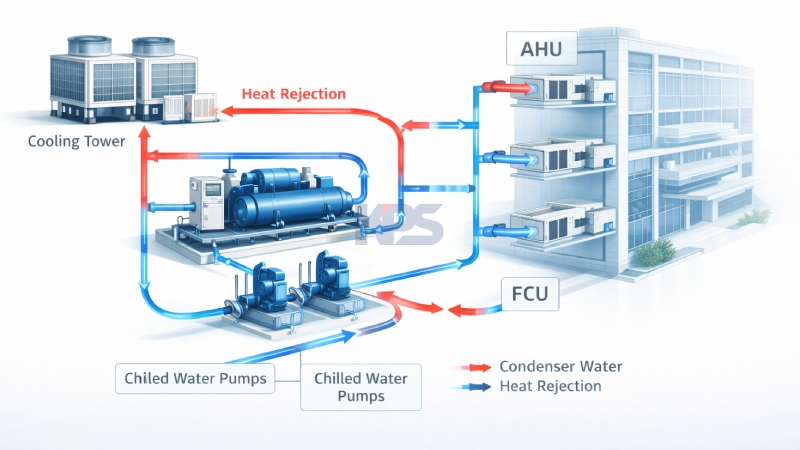
A chiller system uses a central cooling plant to produce chilled water or cooling medium, which is then pumped to AHU/FCU units throughout the building.
Components of a chiller system include:
Chiller systems are suitable for large buildings, shopping malls, factories, and industrial facilities.
VRF (Variable Refrigerant Flow) / VRV (Variable Refrigerant Volume) is a multi-zone air conditioning system.
Key characteristics include:
Operating principle:
This system is suitable for hotels, office buildings, high-end residential complexes, and educational facilities.
In modern buildings-from office towers and shopping malls to hospitals and industrial facilities—HVAC is no longer a secondary system but a core infrastructure that determines operational efficiency, safety, and asset value.
Modern HVAC systems help:
In VRF or chiller systems, part-load control plays a key role in maintaining thermal stability.
In modern buildings, Indoor Air Quality (IAQ) directly affects health, productivity, and building operational value.
HVAC systems play a central role in monitoring, filtering, and maintaining a safe indoor air environment.
According to ASHRAE Standard 62.1, ventilation systems must provide a minimum outdoor airflow rate to maintain a healthy indoor environment.
HVAC systems typically account for 40–60% of total building energy consumption.
Optimizing HVAC systems is therefore critical to reducing Operational Expenditure (OPEX) and improving long-term investment efficiency.
According to ASHRAE Standard 90.1, HVAC system design must meet minimum energy efficiency requirements.
In high-rise buildings and public facilities, smoke—not fire—is the primary cause of fatalities during fires.
Therefore, modern HVAC systems must integrate smoke control, pressurization, and fire spread prevention solutions in compliance with safety regulations.
HVAC systems directly participate in:
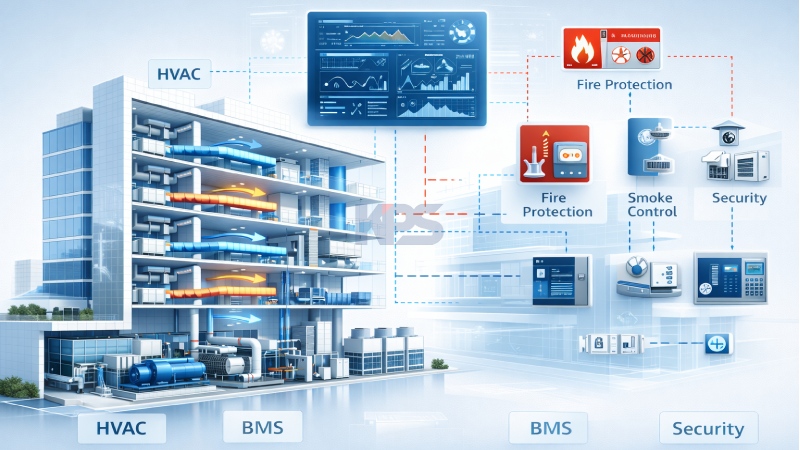
HVAC systems are not only responsible for cooling or ventilation but also serve as a core operational data platform.
When integrated with Building Management Systems (BMS), HVAC becomes the foundation of smart building architecture.
HVAC integration with BMS enables:
BMS allows centralized control of the entire building infrastructure from a single control room.
The quality of the HVAC system not only affects building operations but also directly impacts asset value and brand positioning of building owners.
Modern HVAC systems provide:
With experience in building infrastructure system deployment since 2010, Khai Phat Security Systems Corporation (KPS) provides integrated HVAC solutions within the smart building ecosystem.
Instead of deploying HVAC as a standalone system, KPS focuses on a comprehensive integration approach, where HVAC is connected with critical building systems such as fire alarm systems, security systems, access control, public address systems, and Building Management Systems (BMS/iBMS).
Through partnerships with leading technology providers such as Johnson Controls, Legrand, Bosch, ABB, Simplex, and GST, KPS is capable of implementing HVAC monitoring and control solutions at large scale—from office buildings and hotels to hospitals, data centers, and industrial complexes.
Modern building management platforms enable the collection of data from sensors, air conditioning systems, security devices, and energy management systems to optimize operations, reduce energy consumption, and improve building safety.
With this integrated system approach, KPS not only supplies equipment but also delivers intelligent infrastructure solutions that help buildings operate more efficiently, save energy, and comply with international technical standards.
Contact KPS today to receive technical consultation and the optimal solution for your project.

Other news

Signify and KPS sign strategic partnership agreement.
Signify and KPS have signed a strategic partnership to promote smart, energy-efficient lighting solutions for buildings in Vietnam.
View detail

From APEC 2017 Da Nang to APEC 2027 Phu Quoc: From traditional security solutions to smart IOCs.
From APEC 2017 security monitoring solutions to a smart IOC model for APEC 2027 in Phu Quoc.
View detail

Team Building KPS 2026 | Da Nang - Hoi An - Hue
KPS 2026 Team Building journey in Da Nang - Hoi An - Hue, where teams bond, recharge, and spread sustainable values.
View detail

Optimizing air conditioning based on room conditions in hotels and resorts.
Why do 20-30% of hotel rooms still have their air conditioning running even when there are no guests?
View detail

Energy-saving solutions for hotels and resorts - without compromising the experience.
Consulting and implementing EMS systems for hotels - reducing electricity costs, smarter operation - without compromising customer experience.
View detail

Energy Management System (EMS): Cost and Operation Optimization
EMS solutions help businesses monitor, analyze, and optimize energy in real time, saving 10-30% on electricity costs.
View detail
ABOUT KPS


Regulations and policies
Warranty and return policy Delivery, payment, and feedback Giấy phép kinh doanhContact Information
HO CHI MINH OFFICE
10–12 Dong Van Cong Street, Cat Lai Ward, Ho Chi Minh City.
+842839976099 / 903 709 019
info@kps.com.vn
www.kps.com.vn
Work time
Monday – Friday : 8:00 AM - 17:30 PM
Saturday - Sunday: Off
HA NOI OFFICE
22 Alley 168 Nguyen Xien, Khuong Dinh Ward, Hanoi City
+84 903 709 019
kpshn@kps.com.vn
www.kps.com.vn
Work time
Monday – Friday: 8:00 AM - 17:30 PM
Saturday - Sunday: Off
DA NANG OFFICE
490 Nguyen Tri Phuong, Hoa Cuong Ward, Da Nang City
+84 903 709 019
kpsdn@kps.com.vn
www.kps.com.vn
Work time
Monday – Friday: 8:00 AM - 17:30 PM
Saturday - Sunday: Off
CAN THO OFFICE
11/11 Tran Binh Trong, Ninh Kieu Ward, Ninh Kieu District, Can Tho City.
+84 090 709 019
kpsct@kps.com.vn
www.kps.com.vn
Work time
Monday – Friday: 8:00 AM - 17:30 PM
Saturday - Sunday: Off
SERVICE CENTER - WAREHOUSE
10–12 Dong Van Cong Street, Cat Lai Ward, Ho Chi Minh City.
+ 84 28 3997 0609
baohanh@kps.com.vn
www.kps.com.vn
Work time
Monday – Friday: 8:00 AM - 17:30 PM
Saturday - Sunday: Off
2010 © Bản quyền thuộc KPS
Online: 20 | Visitors Counter: 17310598
About | Recruitment | News | Contact Us


