


info@kps.com.vn
+84 903 709 019
In the era of digital transformation and artificial intelligence, data centers have become the foundation of every technology infrastructure. However, their rapid development has led to huge power consumption and significant CO2 emissions. In response to this challenge, Green Data Centers have emerged as an inevitable solution - ensuring high processing performance while minimizing environmental impact and long-term operating costs.
The explosion of global digital infrastructure in the era of cloud computing, artificial intelligence (AI), Internet of Things (IoT) and 5G is leading to an unprecedented energy consumption crisis. Currently, data centers account for about 3-5% of total global electricity consumption, and this number could double by 2030 without effective mitigation measures.
New generation AI chips and GPUs have increasingly high power density, generating a lot of heat, causing power consumption per rack to increase 3-5 times compared to 2013. This makes the cooling system an economic and environmental bottleneck, forcing data centers to innovate their infrastructure if they want to maintain stable operations.
In Vietnam, setting a PUE performance ceiling of no more than 1.4 in new data centers is a strategic move. This regulation not only demonstrates a commitment to reducing emissions, but also aims to prepare the national infrastructure capacity to serve high-density AI workloads in the future, without overloading the national grid.
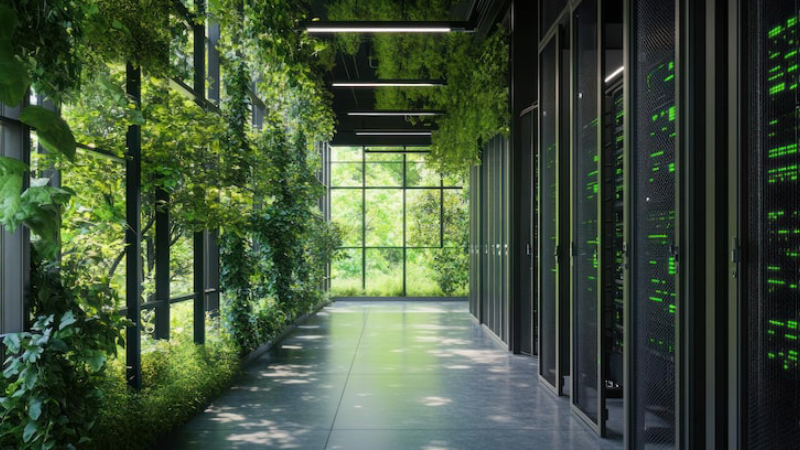
Green Data Center is an IT infrastructure model in which the entire mechanical, electrical, lighting and IT systems are designed, built and operated to maximize energy efficiency and minimize environmental impact, while ensuring the highest performance, availability and information security.
The four core principles of Green Data Centers include:
The international community has established many standards to measure and guide Green Data Centers, including:
These standards not only quantify energy efficiency, but also guide the design, operation and lifecycle assessment of data centers - from construction to demolition.
Converting to a Green Data Center model brings important multi-dimensional benefits:
Optimizing operating costs and Increasing profits (ROI)
Meeting the Sustainable Development Goals (ESG)
Improving national competitiveness and attracting investment
To achieve a PUE index below 1.4 and move towards sustainable operation, modern data centers (TTDL) need to synchronously apply advanced cooling, energy management and IT optimization technologies.
In the context of hot and humid tropical climate and high AI load density, traditional air cooling solutions are no longer suitable. Instead, TTDL needs to switch to:
Context and domestic development trends
In the context of the digital economy becoming a new growth driver, Vietnam is witnessing the explosion of AI, cloud computing, Big Data and online platforms. The telecommunications, banking, e-commerce and e-government sectors all promote the need for storage and processing of huge data - leading to the strong development of domestic Data Center systems.
Leading corporations such as Viettel IDC, VNPT, FPT, CMC are investing in building large-scale data centers that meet international standards, aiming to reduce energy consumption, increase operational efficiency and ensure sustainability. However, the speed of infrastructure expansion is putting significant pressure on the national power system, posing an urgent need to green the data infrastructure.
Vietnam is gradually integrating into the trend of shifting to a Green Data Center model through specific policy moves and development orientations:
The Telecommunications Law 2023 clearly defines the orientation for developing telecommunications infrastructure, cloud computing and data centers "in a sustainable and modern direction", creating a legal corridor for investing in green data centers.
And be planned in association with renewable energy areas, ensuring connectivity, backup and efficient exploitation.
These orientations clearly demonstrate Vietnam's determination to develop sustainable digital infrastructure, while fulfilling its commitment to strive for "0" net emissions by 2050.
Despite its great potential, Vietnam is still in the early stages of the green transition in the data center sector:
To build and operate green data centers, Vietnam needs to synchronize many solutions:
In the era of digital transformation and artificial intelligence, Green Data Centers are not just a trend, but a necessity to optimize operational efficiency, control costs, and ensure sustainable development. KPS System Corp is proud to be a provider of integrated data center infrastructure and technology security solutions, accompanying businesses in building and operating data centers with a Green, Smart, and Secure orientation.
With over 15 years of experience, KPS is currently the official distributor and partner of many leading global technology corporations and brands such as Bosch, Legrand, GST, Simplex, i-PRO, Genetec, MAG, ABB, CNB, Janus Fire, Tycon… Building upon this foundation, KPS has developed a comprehensive and integrated ecosystem of solutions in the field of security and technical infrastructure, providing holistic solutions including: access control, security monitoring, fire alarm and fire suppression systems, building management, electrical and low-voltage infrastructure, meeting the stringent requirements of data centers and critical infrastructure projects.
As a system integrator and trusted solution partner, KPS aims to help customers build internationally standardized data centers that operate stably, safely, and efficiently, while aligning with ESG goals and sustainable development strategies in the digital age.
Explore KPS's integrated security solutions ecosystem here!

Other news

Signify and KPS sign strategic partnership agreement.
Signify and KPS have signed a strategic partnership to promote smart, energy-efficient lighting solutions for buildings in Vietnam.
View detail

From APEC 2017 Da Nang to APEC 2027 Phu Quoc: From traditional security solutions to smart IOCs.
From APEC 2017 security monitoring solutions to a smart IOC model for APEC 2027 in Phu Quoc.
View detail

Team Building KPS 2026 | Da Nang - Hoi An - Hue
KPS 2026 Team Building journey in Da Nang - Hoi An - Hue, where teams bond, recharge, and spread sustainable values.
View detail

Optimizing air conditioning based on room conditions in hotels and resorts.
Why do 20-30% of hotel rooms still have their air conditioning running even when there are no guests?
View detail

Energy-saving solutions for hotels and resorts - without compromising the experience.
Consulting and implementing EMS systems for hotels - reducing electricity costs, smarter operation - without compromising customer experience.
View detail

Energy Management System (EMS): Cost and Operation Optimization
EMS solutions help businesses monitor, analyze, and optimize energy in real time, saving 10-30% on electricity costs.
View detail
ABOUT KPS


Regulations and policies
Warranty and return policy Delivery, payment, and feedback Giấy phép kinh doanhContact Information
HO CHI MINH OFFICE
10–12 Dong Van Cong Street, Cat Lai Ward, Ho Chi Minh City.
+842839976099 / 903 709 019
info@kps.com.vn
www.kps.com.vn
Work time
Monday – Friday : 8:00 AM - 17:30 PM
Saturday - Sunday: Off
HA NOI OFFICE
22 Alley 168 Nguyen Xien, Khuong Dinh Ward, Hanoi City
+84 903 709 019
kpshn@kps.com.vn
www.kps.com.vn
Work time
Monday – Friday: 8:00 AM - 17:30 PM
Saturday - Sunday: Off
DA NANG OFFICE
490 Nguyen Tri Phuong, Hoa Cuong Ward, Da Nang City
+84 903 709 019
kpsdn@kps.com.vn
www.kps.com.vn
Work time
Monday – Friday: 8:00 AM - 17:30 PM
Saturday - Sunday: Off
CAN THO OFFICE
11/11 Tran Binh Trong, Ninh Kieu Ward, Ninh Kieu District, Can Tho City.
+84 090 709 019
kpsct@kps.com.vn
www.kps.com.vn
Work time
Monday – Friday: 8:00 AM - 17:30 PM
Saturday - Sunday: Off
SERVICE CENTER - WAREHOUSE
10–12 Dong Van Cong Street, Cat Lai Ward, Ho Chi Minh City.
+ 84 28 3997 0609
baohanh@kps.com.vn
www.kps.com.vn
Work time
Monday – Friday: 8:00 AM - 17:30 PM
Saturday - Sunday: Off
2010 © Bản quyền thuộc KPS
Online: 37 | Visitors Counter: 17748042
About | Recruitment | News | Contact Us


