


info@kps.com.vn
+84 903 709 019
In recent years, if you pay attention to the spec sheets of new car models, you’ll notice terms like LDWS, LDA, Lane Warning… appearing almost everywhere. This isn’t just a “nice-to-have” feature anymore — it’s becoming a global safety trend, and many countries are beginning to consider it a mandatory standard for new vehicles.
So what exactly is the Lane Departure Warning System (LDWS), why is it so important, and why is it being mentioned so frequently from 2024–2025 onward? This article provides a complete overview from the perspectives of technology, market trends, and safety regulations.
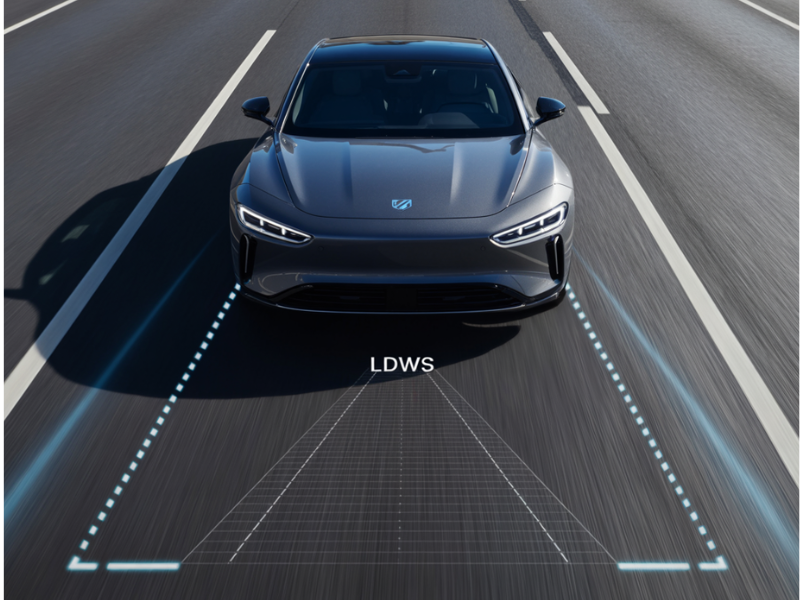
LDWS is a lane departure warning system that uses a front-facing camera to detect lane markings. When the vehicle unintentionally drifts out of its lane without the turn signal on, the system alerts the driver with audible beeps, steering wheel vibration, seat vibration, or warning lights on the dashboard.
Its purpose is to reduce accidents caused by drowsiness, distraction, or smartphone use while driving.
Different car brands use different names:
Toyota: Lane Departure Alert (LDA)
Honda: Road Departure Mitigation (includes steering intervention)
Hyundai/Kia: Lane Departure Warning
Mazda: LDWS
Mercedes/BMW/Audi: Lane Departure Warning / Lane Assist
Despite the different names, the core function is the same: warning the driver when the vehicle drifts out of its lane.
According to NHTSA (U.S. National Highway Traffic Safety Administration) data from 2020–2023, lane departure–related crashes account for more than 25% of all fatal accidents in the U.S. — a significant proportion that highlights driver distraction and unintentional lane drifting as leading causes of severe collisions.
In Europe, Euro NCAP ranks unintentional lane departure among the top three causes of highway fatalities, where even a slight deviation at high speed can lead to catastrophic consequences.
Meanwhile, JNCAP in Japan reported that from 2018–2022:
Vehicles equipped with LDWS or LKA recorded over 40% reduction in accidents related to drowsiness, distraction, or lane drifting.
This proves that LDWS is not an optional “extra feature” — it is one of the most effective life-saving technologies in modern vehicles.
The core component of LDWS is a front-mounted camera, usually positioned behind the windshield. Whether it's a single or dual camera, the principle remains the same: the system continuously monitors lane markings and analyzes the vehicle’s position relative to them.
The camera "sees" the lane — including solid lines, dashed lines, and reflective markings.
The system calculates the distance between the vehicle and both lane edges.
Software predicts movement to determine whether the car is going straight, turning, or drifting.
When the vehicle begins drifting out of its lane without signaling, the system issues alerts via sound, vibration, or visual warnings.
Importantly:
LDWS = warning only
LKA (Lane Keeping Assist) = small steering corrections
LDP (Lane Departure Prevention) = braking on one side to pull the vehicle back into lane

Because LDWS relies entirely on the camera, it’s not always as accurate as drivers expect. The system may shut off or perform poorly when:
Lane markings are faded
The road is wet, covered, or too dark
Speed is too low (many vehicles disable LDWS below 50–60 km/h)
Roads lack clear lane markings
Additionally, dirty windshields, glare from the sun, fog, or rain can disrupt camera vision.
This is why premium brands like Tesla, BMW, and Mercedes use high-resolution cameras, radar, and AI image processing, ensuring better accuracy even in challenging conditions.
LDWS offers very specific and noticeable advantages, especially during high-speed or long-distance driving:
Reduces accidents caused by drowsiness or distraction
LDWS is designed to catch the moments when drivers feel tired, sleepy, or distracted. Alerts help re-focus the driver instantly — a crucial factor in preventing serious accidents.
Helps maintain proper lane position on highways
At high speeds, even slight drifting can be dangerous. LDWS monitors lane boundaries continuously and alerts before the vehicle crosses them, giving the driver time to correct course.
Supports new or inexperienced drivers
Beginners often struggle with lane centering. LDWS helps them:
Avoid over-steering
Stay centered in the lane
Gain confidence faster
Enhances safety at night or in light rain
LDWS cameras may see lane markings more clearly than human eyes under low visibility conditions.
Reduces side collisions
When the vehicle unintentionally drifts left or right, LDWS alerts before touching the lane boundary — preventing side-swipes or collisions in heavy traffic.
When does LDWS perform best?
LDWS works most accurately when:
Lane markings are clear and clean
Weather is good with sufficient light
Roads have proper lane divisions (highways, national roads)
Vehicle speed is moderate to high (above 50–60 km/h)
LDWS is not just a standalone feature — it is the foundation of modern driver assistance systems (ADAS).
LDWS is the first building block toward self-driving technology
It typically integrates with:
LKA – lane-keeping assist
ACC – adaptive cruise control
AEB – automatic emergency braking
When combined, these systems enable Level 2 autonomous functions similar to Tesla, Volvo, Mercedes, BMW, and Hyundai.
LDWS in the future: smarter, more accurate, and road-aware
In the next few years, LDWS will evolve beyond a 720p camera reading road markings. Automakers are moving toward:
Higher-resolution cameras
Wide-angle radar
AI-based image processing
These upgrades will allow the system to detect:
Faded or damaged lane markings
Water-covered lines
Extremely poor road visibility
Even “missing” lane markings through predictive modeling
Proactive — making small steering corrections
Reliable — even without clear lane markings
Smart — using map data, traffic signs, and 8K cameras
Predictive — adjusting the vehicle’s path before drifting happens
Today, LDWS acts like “a co-driver reminding you to stay alert”.
In the near future, LDWS will become the central road-perception intelligence, essential for Level 3 autonomous driving.
If sensor and software development continue at the current pace, LDWS will soon become a core technology enabling vehicles to operate semi-autonomously without constant driver intervention.
Other news

Signify and KPS sign strategic partnership agreement.
Signify and KPS have signed a strategic partnership to promote smart, energy-efficient lighting solutions for buildings in Vietnam.
View detail

From APEC 2017 Da Nang to APEC 2027 Phu Quoc: From traditional security solutions to smart IOCs.
From APEC 2017 security monitoring solutions to a smart IOC model for APEC 2027 in Phu Quoc.
View detail

Team Building KPS 2026 | Da Nang - Hoi An - Hue
KPS 2026 Team Building journey in Da Nang - Hoi An - Hue, where teams bond, recharge, and spread sustainable values.
View detail

Optimizing air conditioning based on room conditions in hotels and resorts.
Why do 20-30% of hotel rooms still have their air conditioning running even when there are no guests?
View detail

Energy-saving solutions for hotels and resorts - without compromising the experience.
Consulting and implementing EMS systems for hotels - reducing electricity costs, smarter operation - without compromising customer experience.
View detail

Energy Management System (EMS): Cost and Operation Optimization
EMS solutions help businesses monitor, analyze, and optimize energy in real time, saving 10-30% on electricity costs.
View detail
ABOUT KPS


Regulations and policies
Warranty and return policy Delivery, payment, and feedback Giấy phép kinh doanhContact Information
HO CHI MINH OFFICE
10–12 Dong Van Cong Street, Cat Lai Ward, Ho Chi Minh City.
+842839976099 / 903 709 019
info@kps.com.vn
www.kps.com.vn
Work time
Monday – Friday : 8:00 AM - 17:30 PM
Saturday - Sunday: Off
HA NOI OFFICE
22 Alley 168 Nguyen Xien, Khuong Dinh Ward, Hanoi City
+84 903 709 019
kpshn@kps.com.vn
www.kps.com.vn
Work time
Monday – Friday: 8:00 AM - 17:30 PM
Saturday - Sunday: Off
DA NANG OFFICE
490 Nguyen Tri Phuong, Hoa Cuong Ward, Da Nang City
+84 903 709 019
kpsdn@kps.com.vn
www.kps.com.vn
Work time
Monday – Friday: 8:00 AM - 17:30 PM
Saturday - Sunday: Off
CAN THO OFFICE
11/11 Tran Binh Trong, Ninh Kieu Ward, Ninh Kieu District, Can Tho City.
+84 090 709 019
kpsct@kps.com.vn
www.kps.com.vn
Work time
Monday – Friday: 8:00 AM - 17:30 PM
Saturday - Sunday: Off
SERVICE CENTER - WAREHOUSE
10–12 Dong Van Cong Street, Cat Lai Ward, Ho Chi Minh City.
+ 84 28 3997 0609
baohanh@kps.com.vn
www.kps.com.vn
Work time
Monday – Friday: 8:00 AM - 17:30 PM
Saturday - Sunday: Off
2010 © Bản quyền thuộc KPS
Online: 39 | Visitors Counter: 18056773
About | Recruitment | News | Contact Us


.png)


