KPS System Corp | Công ty cổ phần Hệ Thống An Ninh Khai Phát

VMS centralized camera management solution

In the era of digitalization and automation, security monitoring does not stop at just observing images but requires a smart, synchronous and flexible management solution. KPS's VMS (Video Management System) was born to meet that need - helping businesses and organizations manage and control the entire camera system effectively, safely and easily expand according to the scale of operation.

General introduction to VMS system

What is VMS?

VMS (Video Management System) is a centralized video management software system that allows connection, control, storage and monitoring of images from many different cameras on the same platform. VMS acts as the operating center of the camera system, the manager can:

  • Monitor live images from many areas.
  • Record and review data easily.
  • Integrate artificial intelligence (AI) to analyze behavior, recognize faces, and warn of incidents.
  • Manage user authorization and ensure data security.

The role of VMS in modern surveillance systems

In the digital age and the trend of smart cities, VMS plays a core role in helping to:
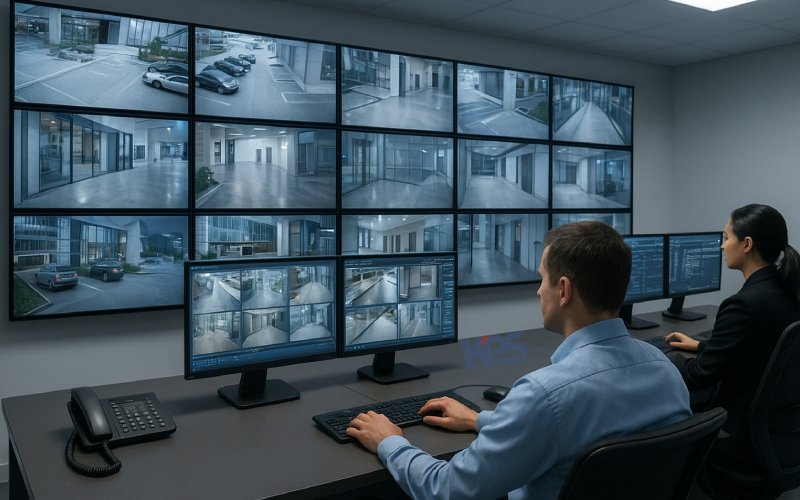
  • Centralize surveillance data, instead of each area having a separate system, all are connected to a single management center.
  • Optimizing operations and monitoring helps the security department control hundreds, even thousands of cameras on just one control screen.
  • Multi-system integration makes it easy to connect to Access Control, Fire Protection, Alarm, BMS or IoT systems.
  • Smart analysis thanks to AI and machine learning, VMS can automatically identify abnormal behavior, early warning of incidents.

Challenges in managing traditional camera systems

Surveillance camera systems are an indispensable part of security management for businesses, industrial parks, buildings or urban areas. However, traditional camera models, which are deployed separately and independently in each area, have many major limitations when the need for monitoring and analysis is increasingly complex. This creates many problems in the management, operation and expansion of the system.

Here are some of the common challenges that businesses, investors and managers often encounter:

Distributed monitoring data, difficult to control

Traditional camera systems are often managed independently through individual video recorders (NVR/DVR), fragmented data, causing difficulties in operation, control and information retrieval when there is an incident.

  • Video data is stored separately and asynchronously.
  • Operators must access each different system to view or download videos.
  • Cannot observe the entire area on a single interface.

Limitations in system expansion and integration

Traditional camera systems are often only compatible within the same brand, lack of open standard support (such as ONVIF) leading to system rigidity, difficult to meet future development requirements.

  • When wanting to expand or upgrade, it is easy to have device or software conflicts.
  • Cannot integrate with other systems such as access control, fire alarm, alarm or BMS.
  • Expanding the system becomes costly and complicated.

Manual video search and retrieval, time-consuming

The traditional camera model of retrieving video when there is an incident often requires manual access to each recorder, which reduces the efficiency of troubleshooting and increases the risk of losing important visual evidence.

  • There is no smart search feature by event, area or object.
  • Video review and download takes a lot of time, especially when there are hundreds of cameras.
  • Data is easily overwritten or lost if storage capacity is not well controlled.

No intelligent analysis capabilities

Traditional cameras are not equipped with AI technology or advanced data analysis, only stop at reviewing images, not creating useful data value for operations or decision making.

  • Cannot recognize faces, count people, recognize license plates or detect abnormal behavior.
  • No ability to warn early when risks or incidents are detected.

Limited access and data security

Video data is mainly stored locally, without advanced security mechanisms. This is a major risk to data security, especially for organizations with high security requirements such as banks, governments or factories.

  • Vulnerable to unauthorized access, copying or deleting data.
  • No clear user authorization.
  • Does not support modern encryption standards (such as HTTPS, AES, FIPS)

High labor and operating costs

Each recorder, each area requires its own personnel to monitor, maintain and manage data, leading to high labor and operating costs, while monitoring performance is not commensurate.

  • There is no centralized tool to monitor multiple points at the same time.
  • Maintenance, software updates or configuration must be done manually on each device.

Does not meet large-scale management requirements

When the number of cameras increases, the system is no longer capable of stable operation. This makes the traditional model unable to meet the centralized management requirements of large-scale projects such as airports, industrial parks or smart buildings.

  • Limit the number of devices on each recorder.
  • No ability to synchronize data across the system.
  • Cannot be centrally monitored or remotely operated over the network. VMS centralized camera management solution.

VMS system structure in real model

A modern VMS system is designed with a flexible structure, allowing the management of thousands of cameras from many different areas and locations through a centralized platform. This structure is built on the principles of open - secure - expandable - synchronous, ensuring stable operation in large-scale application environments such as: airports, commercial centers, industrial parks, factories, smart buildings, etc.

The VMS system structure in real model is often divided into three main layers:

Input device layer: this layer has the role of collecting and transmitting image data, events and warnings to the central system.

  • Including IP cameras, encoders (converting analog signals to IP) and on-site recording devices.
  • Cameras can come from many different brands but still operate synchronously thanks to open standard protocols (ONVIF, RTSP, SDK...).
  • Some cameras support integrated AI, helping the system process data more intelligently right from the source.

Central layer: this layer has the role of central processing, managing all cameras, storing and analyzing data.

  • VMS Server: responsible for receiving, processing and storing images/videos from cameras.
  • Database Server: stores configuration information, users, event logs, video metadata.
  • AI/Analytics Server (optional): processes advanced image analysis features such as facial recognition, people counting, license plate recognition (LPR), intrusion detection, etc.
  • Storage Server (Storage Server/NAS/SAN): provides large capacity to store video data for a long time, ensuring safety and fast retrieval.

User interface layer: this layer has the role of providing an intuitive interface for monitoring, operating and making quick decisions.
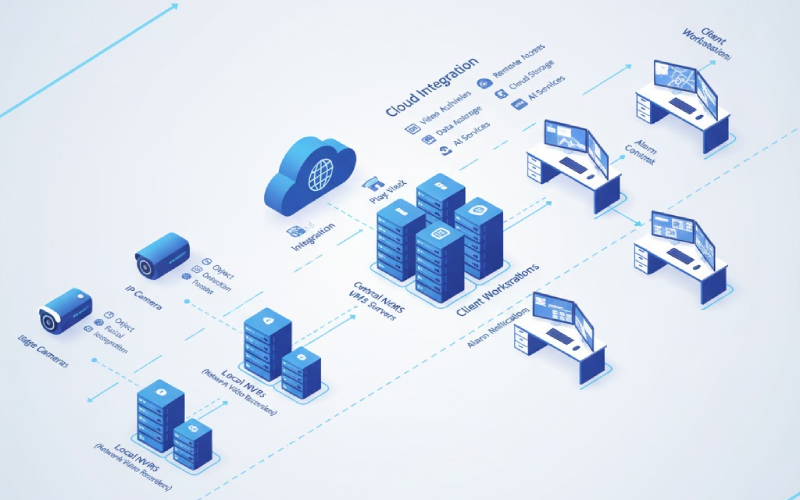
  • Client software (Desktop/Web): allows operators to access the system to view live, review, search, or configure cameras.
  • Mobile application (Mobile App): supports remote access, receives real-time alerts.
  • Video Wall/Control Room: displays multiple video channels simultaneously, used in surveillance operations centers (SOC, NOC).

Outstanding features of modern VMS systems

VMS (Video Management System) is not simply a camera management software, but a comprehensive monitoring and operating platform - where all images, data, events and warnings are centralized, analyzed and displayed visually.

Centralized management of the entire camera system helps improve overall control, reduce system operation and maintenance work.

  • Allows management of hundreds to thousands of IP cameras from many different areas, buildings or branches on a single platform.
  • Intuitive map interface (Map View) helps locate each camera by area.
  • Easily group, search, access and directly monitor each area according to the administrative level.
  • Support multiple users to access at the same time, with detailed authorization mechanism.

Smart recording and storage helps ensure video data security, serving retrieval and verification requirements when needed.

  • Allows continuous, scheduled or event-based recording to save space.
  • Supports multiple flexible storage methods: local storage, NAS, SAN, or Cloud Storage.
  • Built-in failover / redundancy mechanism ensures data is not lost in the event of an incident.
  • Flexible storage expansion capability, RAID support and long-term storage capacity.

Smart video search and retrieval helps shorten search time, increase investigation and incident analysis efficiency.

  • Search videos by time, event, area or object type.
  • Allows simultaneous review of multiple cameras, fast-forward, slow-down or mark important moments.
  • Some systems integrate AI search, allowing video filtering by color, vehicle, behavior, face, etc.

Intelligent image analysis (AI Video Analytics) or connecting to a dedicated AI server for advanced image data processing

  • Face recognition
  • License plate recognition
  • Detect intrusion or abnormal behavior
  • Count people, monitor traffic or analyze crowds
  • Warning when detecting abandoned objects, objects being taken
  • Classify objects such as people, vehicles, objects, etc.

Real-time monitoring and warning help operators respond quickly and accurately to all situations.

  • Display live video in grid, map, or configure separately for each area.
  • Automatically issue warnings (sound, popup, email, SMS, push notification) when detecting abnormal events.
  • Allows customizing warning thresholds and integrating with other security systems such as fire alarms, access control, alarms, etc.
  • User management and access authorization help ensure data security, limiting access according to the responsibilities of each level.

Supports user management by role (Admin, Operator, Viewer, etc.).

  • Detailed authorization by camera group, area or feature.
  • Saves all access and operation history (Audit Log) for inspection and security purposes.
  • Integrated with authentication systems such as Active Directory / LDAP.

Easy integration and expansion ensure long-term development for businesses, helping to reduce investment costs.

  • Supports open protocol standards such as ONVIF, RTSP, SDK, allowing connection to many different camera brands.
  • Easy integration with other systems: Access Control, BMS, Fire Alarm, SCADA, Smart Building, ...
  • Allows flexible expansion by adding new cameras, servers, or sites without changing the entire system.

Supports multi-platform operation, easy to use, suitable for all monitoring environments.

  • Access via Client software, Web Browser or Mobile App.
  • Supports user-friendly interface, multi-screen display, drag - drop - direct PTZ control.
  • Integrated Video Wall / Control Room for large-scale operations centers.

Intuitive interface - advanced reporting and statistics help operators grasp the entire system through just one screen.

  • Displays area maps, device diagrams, camera status by color.
  • Provides automatic reports on system status, storage capacity, warning logs.
  • Allows customization of intuitive statistical dashboards, supporting quick decision making.

High-level data security, ensuring absolute integrity and security of surveillance data.

  • Encrypt video data during transmission (HTTPS, TLS, AES).
  • Support two-factor authentication (2FA) and security certificates.
  • System Log and detect abnormal access.
  • Some high-end solutions meet FIPS 140-2 security standards, NDAA compliance, meeting the requirements of governments and defense organizations.

With centralized management, AI analysis, high security and flexible scalability, VMS is the foundation solution for smart surveillance infrastructure in the IoT and Smart City era.

Practical applications

Thanks to its flexible scalability, centralized management and AI technology integration, VMS is widely applied in many fields - from urban security to smart building operations, industrial infrastructure and data centers.

Airports, terminals and transportation centers: help improve aviation security, optimize airport operations and minimize safety risks.

  • Manage thousands of surveillance cameras in terminal areas, parking lots, aircraft parking lots, runways, screening areas and customs.
  • Support tracking passenger movements, detect abnormal behavior or restricted areas.
  • Integrate with access control systems, fire alarms, radars and airport operations centers.
  • Enable real-time monitoring from the command center (Airport Operation Center).

Data Center and IT infrastructure: help minimize the risk of physical intrusion, support operational control and compliance with security procedures.

  • 24/7 security monitoring at server rooms, entrances, technical areas, racks, UPS, cooling systems.
  • Integrate VMS with access control systems, environmental sensors and temperature/humidity warnings.
  • Record and store all activities of technical staff in restricted areas.
  • Ensure high security standards, comply with international standards (FIPS, NDAA, ISO/IEC 27001).

Industrial parks, factories and production areas: help improve labor safety, effectively manage human resources, optimize operating processes and protect assets.

  • Monitor the entire factory area, warehouse, entrance gate, dangerous areas or production lines.
  • Analyze behavior, count people, detect workers not wearing protective helmets or violating safety procedures.
  • Integrate with Access Control, Fire Alarm, automatic warning system when there is an incident.
  • Centralized management of multiple factories in different areas on a single VMS platform.

Banks & financial institutions: improve security levels, support investigation and quick handling of incidents in the financial sector.

  • Monitor branches, ATMs, vaults, transaction areas and security corridors.
  • Analyze suspicious behavior, recognize customer faces, detect subjects wearing masks or covering their faces.
  • Automatically synchronize video data between branches and bank operations centers.
  • Ensure video data integrity, encrypt according to high security standards.

Buildings, commercial centers and urban areas: help ensure security and safety for residents and customers, improve building operation experience.

  • Manage cameras in lobbies, basements, elevators, corridors, public areas, parking lots, etc.
  • Synchronously integrate with BMS (Building Management System) to control and monitor smart buildings.
  • Support facial recognition, license plate recognition, automatic access control.
  • Provide real-time alerts to the security center.

Urban traffic and smart city (Smart City): VMS helps support smart urban management, reduce congestion and improve traffic safety.

  • Integrate thousands of traffic cameras, fine cameras, urban surveillance cameras into the centralized VMS platform.
  • Analyze traffic behavior, recognize license plates, detect violations, measure vehicle traffic.
  • Integrate data with ITS systems, urban operation centers (IOC) or regional security centers.
  • Allow multi-level monitoring - from neighborhoods, routes to the entire city.

Energy, oil and gas and critical infrastructure: help ensure absolute safety for important infrastructure, prevent incidents and major damage.

  • Security monitoring at power plants, transformer stations, drilling rigs, fuel depots, pumping stations, etc.
  • Early warning when detecting leaks, explosions, or illegal intrusions.
  • Integrate video data with SCADA, industrial control systems (ICS).
  • Support remote access for technical teams when incidents occur.

Education and healthcare systems: create a safe learning - working - treatment environment, improve management quality.

  • Security monitoring at school gates, campuses, hallways, classrooms, patient areas and parking lots.
  • Record images, control people entering and exiting, support prevention of violence, theft, or insecurity.
  • Combine with AI facial recognition and people counting for effective entry and exit management.
  • Deploy centralized management of multiple facilities.

Criteria for selecting the right VMS system

Choosing the right VMS system plays a key role in ensuring stable operation, security and optimal performance for the entire surveillance system. Some important criteria to consider when choosing:

System scalability and flexibility

  • The VMS needs to support easy scaling when the number of cameras increases or when the system is deployed in many different areas.
  • The ability to integrate with a variety of devices from many brands, ensuring that it is not dependent on a single manufacturer.

System compatibility and integration

  • The VMS should support standard ONVIF protocols or open standards such as RTSP, BACnet, Modbus, etc. to easily connect with other systems such as access control, fire alarm, public address systems or BMS.
  • The ability to integrate API or SDK allows customization and connection with existing management software.

Processing and storage performance

Ensure stable performance when processing high-resolution video or real-time monitoring of hundreds of channels at the same time.

  • Support smart recording, video streaming, bandwidth optimization and storage capacity.
  • Can integrate NAS/SAN or cloud storage (Cloud Storage) for distributed models.

Smart analysis and management capabilities

  • Modern VMS should be integrated with AI Video Analytics to detect motion, facial recognition, behavior analysis, people counting, license plate recognition (ANPR), ...
  • Allow automatic alert creation, statistical reports and smart video search to reduce management time.

Security and user authorization

  • VMS needs to ensure high security standards (SSL, HTTPS, AES encryption, MFA multi-factor authentication).
  • Support detailed authorization by role to ensure security and compliance with data regulations.

Intuitive and user-friendly interface

  • The management interface needs to be easy to use, displayed visually on maps and area diagrams.
  • Support multiple access platforms (Web, Mobile App, Client) to help managers monitor remotely anytime, anywhere.

Technical support and software update services

  • Choose a supplier with warranty services, in-depth technical support, training and regular software updates.
  • VMS has a clear upgrade roadmap, supports feature updates and periodic security patches.

Investment costs and operational optimization

  • Consider the total cost of ownership (TCO) including: software copyright, hardware, maintenance, upgrades and operating personnel.
  • Prioritize flexible solutions in terms of deployment models: On-premise, Cloud or Hybrid to suit the budget and specific project characteristics.

VMS solution provided by KPS

With many years of experience in deploying large-scale surveillance, security control and image management systems, KPS is proud to bring a modern, flexible and optimal VMS centralized camera management solution for all construction models - from businesses, buildings, urban areas to key national infrastructure.

KPS provides a modern VMS solution, helping businesses and projects manage the entire surveillance system on a single platform. The system allows real-time video monitoring, control and analysis with an intuitive, user-friendly and easy-to-operate interface. The solution stands out with the ability to integrate multiple camera brands via ONVIF standard, and flexibly expand with other systems such as access control, fire alarm, public address, BMS and AI Video Analytics.

Integrated AI technology helps recognize faces, license plates, detect abnormal behavior, support instant warnings and optimize monitoring work. All data is encrypted for high security, with detailed access permissions and on-premise, cloud or hybrid deployment support depending on your needs.

Why choose KPS as a VMS solution provider?

  • A leading unit in the field of security - surveillance, implementing many large-scale projects nationwide.
  • A synchronized ecosystem including cameras, access control, audio, fire protection, parking management, network infrastructure...
  • Advanced technology meets the requirements of modern projects.
  • A team of professional, experienced engineers, consulting - designing - implementing - maintaining.
  • 24/7 technical support: Dedicated after-sales service, ensuring stable, safe and efficient system operation.
  • KPS is a trusted partner: Official distributor of many of the world's leading security brands, ensuring product quality and origin.

KPS - Accompanying businesses on the journey to build a smart, safe and sustainable security system!

KPS System Corp.


Câu hỏi thờng gặp

Hệ thống VMS khác gì so với NVR thông thường?
NVR chỉ ghi hình và lưu trữ video tại chỗ, trong khi VMS có thể quản lý nhiều NVR, nhiều điểm giám sát khác nhau, hỗ trợ xem từ xa, phân tích AI và quản lý tập trung quy mô lớn.
VMS có cần phần cứng riêng không?
Tuỳ quy mô hệ thống. Với doanh nghiệp lớn, VMS thường được cài trên máy chủ (server) riêng để đảm bảo hiệu suất và dung lượng lưu trữ. Với hệ thống nhỏ, có thể triển khai trên máy trạm hoặc máy chủ ảo.
Hệ thống VMS có tương thích với nhiều hãng camera khác nhau không?
Có. Các phần mềm VMS hiện đại hỗ trợ giao thức ONVIF, giúp dễ dàng kết nối và quản lý nhiều thương hiệu camera khác nhau.

Other news

Security Monitoring Solutions for Data Center

Security Monitoring Solutions for Data Center

A Data Center (DC) is the central location that houses all servers, storage systems, and mission-critical infrastructure of an organization. Even a minor incident — power loss,..

View detail

KPS accompanies Gia Dinh University at the Workshop:

KPS accompanies Gia Dinh University at the Workshop:

KPS and Gia Dinh University organized the Workshop "AI Everywhere", sharing AI applications from experts from CNB, Seagate, Mitel, inspiring technology for Gen Z.

View detail

LEGO Binh Duong Factory | Zero-Emission Factory in Vietnam

LEGO Binh Duong Factory | Zero-Emission Factory in Vietnam

LEGO Binh Duong Factory - a 1.3 billion USD FDI project that meets Carbon Neutral standards, a symbol of green and high-tech production in Vietnam.

View detail

Trends and policies for developing Green Data Centers

Trends and policies for developing Green Data Centers

Vietnam promotes green data centers, towards sustainable digital infrastructure, energy efficiency and carbon emission reduction.

View detail

AI cameras record sharp decrease in traffic violations in Ho Chi Minh City

AI cameras record sharp decrease in traffic violations in Ho Chi Minh City

KPS – đơn vị tiên phong cung cấp giải pháp giám sát giao thông thông minh, ứng dụng camera AI giúp nâng cao an toàn, giảm vi phạm và tối ưu vận..

View detail

EN 54 Standard - Meaning and application in fire alarm systems

EN 54 Standard - Meaning and application in fire alarm systems

EN 54 is a series of European Standards for fire detection and alarm systems.

View detail

1 2 3 4 5
Công ty cổ phần Hệ Thống An Ninh Khai Phát (gọi tắt là Công ty KPS). GPDKKD: 0310471658 do sở KH & ĐT TP.HCM cấp ngày 24/11/2010. Đại diện pháp luật: Đinh Tấn Đạt.

2010 © Bản quyền thuộc KPS

Online: 9 | Visitors Counter: 13390270

About | Recruitment | News | Contact Us

zalo
messenger