


info@kps.com.vn
+84 903 709 019
Smart Buildings are becoming a trend in modern urban settings, optimizing operations, saving energy, and enhancing user experiences. But how can a building "self-operate" effectively? The secret lies in the SCADA system – an advanced monitoring and control technology that allows real-time management of all building activities. So how does SCADA work, and what role does it play in smart buildings? Let's explore with KPS in the article below!
SCADA (Supervisory Control and Data Acquisition) is a remote monitoring, control, and data acquisition system that helps manage and operate automated systems efficiently. SCADA is widely used in industries such as energy, transportation, and especially in smart buildings.
The SCADA system operates by collecting data from sensors, measurement devices, and controllers (PLC, RTU), then transmitting the data to the control center for analysis and executing remote control commands. Thanks to this, SCADA optimizes performance, minimizes risks, and ensures system stability in real-time.
SCADA plays a central role in automating and managing a smart building, helping to monitor, control, and optimize key systems such as power, HVAC, lighting, security, and water.
Collects data from sensors and subsystems.
Helps managers track operational status and make quick decisions.
Adjusts HVAC and lighting systems based on usage demand.
Reduces energy waste and enhances building efficiency.
Detects faults or potential failures and sends immediate alerts.
Supports proactive maintenance and reduces operational downtime.
Connects with BMS (Building Management System), IoT, and AI for comprehensive automation.
Enables remote control via computers or mobile devices.
Monitors camera systems, access control, fire alarms, and water systems.
Ensures a safe living and working environment for residents.
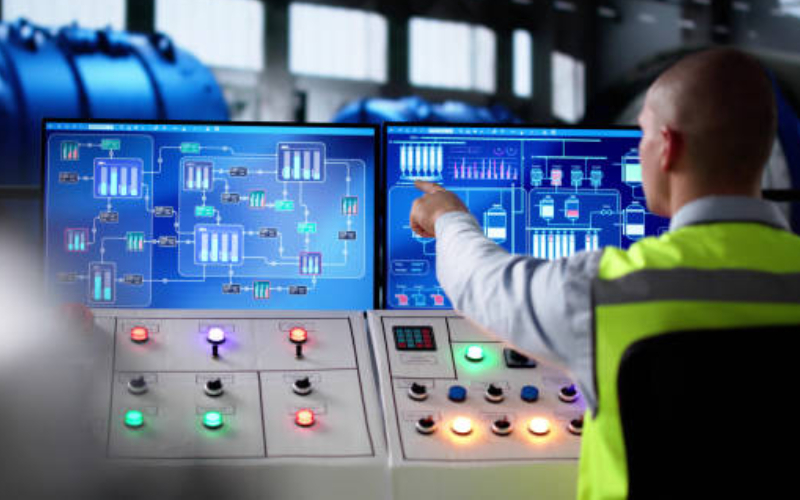
The SCADA system consists of four main components that work together to collect, monitor, and control data in real-time:
PLC (Programmable Logic Controller): A programmable controller that executes automated control commands.
RTU (Remote Terminal Unit): A device that collects data from sensors and transmits it to the control center.
Includes sensors and measurement devices (temperature, humidity, pressure, water level, electricity, etc.) to collect real-world data.
Processes, stores, and displays data from control devices.
Allows operators to monitor, analyze, and control the system remotely.
A control panel that enables technicians to interact with the SCADA system.
Can be a touchscreen, computer, or mobile device.
The SCADA system operates based on the principles of monitoring, data collection, processing, and remote control, ensuring effective management of smart building systems.
Sensors (temperature, humidity, pressure, electricity, water level, etc.) collect information from the real-world environment.
PLC/RTU controllers receive data from sensors and terminal devices within the building system (HVAC, lighting, security, etc.).
PLC/RTU sends data to the SCADA server via communication networks such as Ethernet, Wi-Fi, fiber optics, radio waves, or 4G/5G.
Ensures real-time data updates.
The SCADA server analyzes, stores, and displays data on the HMI interface.
Managers can monitor the system via computer screens, tablets, or phones.
SCADA can automatically adjust the system (increase/decrease temperature, turn devices on/off, adjust lighting, etc.) based on preset configurations.
Operators can also manually control the system via HMI when necessary.
All operational data is stored for performance analysis, failure prediction, and system optimization.
The system can issue early warnings to support proactive maintenance and prevent breakdowns.
Monitoring and optimizing electricity consumption, reducing waste, and improving energy efficiency.
Automatically adjusting temperature, humidity, and airflow to create a comfortable environment while saving energy.
Automatically turning lights on/off and adjusting brightness based on real conditions, reducing electricity consumption.
Connecting with camera systems, electronic locks, and access cards for entry control and intrusion alerts.
Managing water supply & fire protection: Monitoring water pressure, detecting leaks, alerting fire hazards, and automatically activating fire suppression systems.
Remote monitoring and control of building systems via computers and smartphones, enabling fast and efficient maintenance.
The SCADA system is continuously improving to meet the increasing demands of automation, operational optimization, and enhanced user experience in smart buildings.
AI helps SCADA predict failures, optimize operations, and save energy based on collected data.
Big Data optimizes system performance and provides intelligent recommendations for improvements.
IoT allows SCADA to collect data from more sensors, enabling precise and comprehensive monitoring.
Supports remote control and flexible automation, enhancing building management capabilities.
Allows system management, monitoring, and control from anywhere via cloud platforms.
Reduces IT infrastructure costs and enhances scalability and data security.
Advanced security solutions such as data encryption, firewalls, and multi-factor authentication (MFA) help prevent cyberattacks.
Ensures safety and security for building operational data.
Wireless connectivity expands the SCADA system without complex cabling infrastructure.
5G technology enables faster data transmission, ensuring more accurate real-time control.
SCADA will be closely integrated with BMS to manage electricity, water, HVAC, security, and lighting on a unified platform.
Enhances operational efficiency, cost savings, and environmental sustainability.

KPS is the official distributor of top global brands in security, surveillance, low-voltage electrical systems, and automation, including:
i-PRO, CNB, Bosch, Tycon – High-quality surveillance cameras, security, and access control systems.
Genetec – Intelligent integrated security management solutions.
Janus Fire System, GST – International standard fire suppression systems.
MAG, Kumahira – Access control and security door solutions.
Legrand – Advanced electrical and low-voltage systems.
Building security & surveillance cameras
Access control, time attendance & entry management
Fire alarm & automatic fire suppression systems
Public address, conference & performance audio systems
LAN, Wi-Fi & signal transmission networks
Smart home & automation solutions
With extensive industry experience, KPS has successfully implemented projects of all sizes, catering to offices, industrial zones, shopping centers, hotels, hospitals, and schools. We are committed to providing cost-effective solutions with superior quality.
Contact KPS now for a detailed quotation and the best solution for your project!

Other news

Signify and KPS sign strategic partnership agreement.
Signify and KPS have signed a strategic partnership to promote smart, energy-efficient lighting solutions for buildings in Vietnam.
View detail

From APEC 2017 Da Nang to APEC 2027 Phu Quoc: From traditional security solutions to smart IOCs.
From APEC 2017 security monitoring solutions to a smart IOC model for APEC 2027 in Phu Quoc.
View detail

Team Building KPS 2026 | Da Nang - Hoi An - Hue
KPS 2026 Team Building journey in Da Nang - Hoi An - Hue, where teams bond, recharge, and spread sustainable values.
View detail

Optimizing air conditioning based on room conditions in hotels and resorts.
Why do 20-30% of hotel rooms still have their air conditioning running even when there are no guests?
View detail

Energy-saving solutions for hotels and resorts - without compromising the experience.
Consulting and implementing EMS systems for hotels - reducing electricity costs, smarter operation - without compromising customer experience.
View detail

Energy Management System (EMS): Cost and Operation Optimization
EMS solutions help businesses monitor, analyze, and optimize energy in real time, saving 10-30% on electricity costs.
View detail
ABOUT KPS


Regulations and policies
Warranty and return policy Delivery, payment, and feedback Giấy phép kinh doanhContact Information
HO CHI MINH OFFICE
10–12 Dong Van Cong Street, Cat Lai Ward, Ho Chi Minh City.
+842839976099 / 903 709 019
info@kps.com.vn
www.kps.com.vn
Work time
Monday – Friday : 8:00 AM - 17:30 PM
Saturday - Sunday: Off
HA NOI OFFICE
22 Alley 168 Nguyen Xien, Khuong Dinh Ward, Hanoi City
+84 903 709 019
kpshn@kps.com.vn
www.kps.com.vn
Work time
Monday – Friday: 8:00 AM - 17:30 PM
Saturday - Sunday: Off
DA NANG OFFICE
490 Nguyen Tri Phuong, Hoa Cuong Ward, Da Nang City
+84 903 709 019
kpsdn@kps.com.vn
www.kps.com.vn
Work time
Monday – Friday: 8:00 AM - 17:30 PM
Saturday - Sunday: Off
CAN THO OFFICE
11/11 Tran Binh Trong, Ninh Kieu Ward, Ninh Kieu District, Can Tho City.
+84 090 709 019
kpsct@kps.com.vn
www.kps.com.vn
Work time
Monday – Friday: 8:00 AM - 17:30 PM
Saturday - Sunday: Off
SERVICE CENTER - WAREHOUSE
10–12 Dong Van Cong Street, Cat Lai Ward, Ho Chi Minh City.
+ 84 28 3997 0609
baohanh@kps.com.vn
www.kps.com.vn
Work time
Monday – Friday: 8:00 AM - 17:30 PM
Saturday - Sunday: Off
2010 © Bản quyền thuộc KPS
Online: 39 | Visitors Counter: 17748069
About | Recruitment | News | Contact Us


