


info@kps.com.vn
+84 903 709 019
In the context of digital transformation becoming a strategic priority of the manufacturing industry, the MES system is considered the core platform to help businesses improve productivity, optimize costs and build smart factories according to Industry 4.0 standards. More than just a software to monitor the production line, MES plays the role of an "operational brain", seamlessly connecting the management level (ERP) and the control system (SCADA/PLC), collecting and standardizing real-time data, coordinating production according to plan, ensuring quality and comprehensive traceability. The following article will provide a comprehensive view of MES: from concepts, roles, principles, applications by industry, benefits, criteria for choosing solutions, to the latest MES trends in the Industry 4.0 era to help businesses build effective and sustainable implementation strategies.
Manufacturing Execution System (MES) is a production management and execution system that connects the enterprise management level (ERP) and the factory control level (SCADA/PLC/IoT). MES collects real-time data from the production line, thereby monitoring - controlling - optimizing the entire production activities of the factory.
Simply put, MES manages the entire production process, from input materials to finished products, while ensuring quality control and optimizing production processes. MES collects real-time production data from the factory floor, allowing businesses to evaluate production efficiency and make strategic decisions based on real-time information. The system acts as a "production executive", directly managing progress, controlling quality, and operating on-site equipment maintenance.
MES brings many important benefits in modern manufacturing:
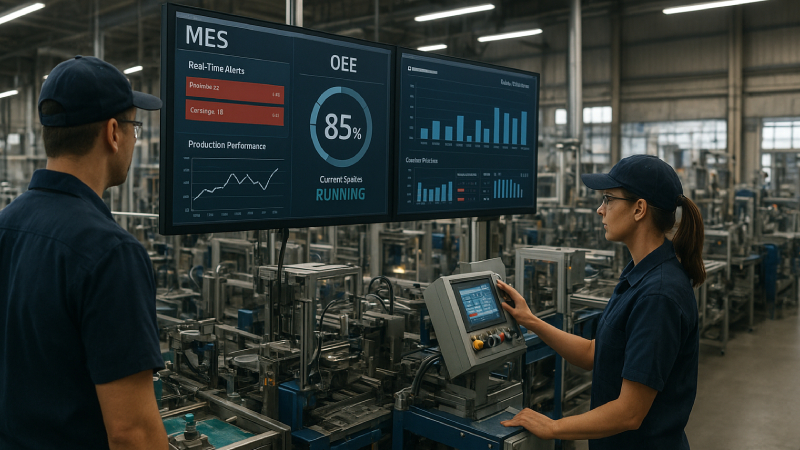
The MES system operates based on collecting - processing - synchronizing - displaying - optimizing production data in real time. The core operating principle includes 5 main steps:
Data collection is the most important step, this is the foundation that helps the system understand how the machine is running, how the product is, and whether the quality is up to standard or not. MES collects data in real-time from multiple layers in the factory, ensuring that all information is updated continuously and accurately.
Collect data from other systems: WMS, LIMS, QMS...
Data collected includes:
Data Processing & standardization
After MES collects data from machines, sensors, PLCs and workers, the next important step is to process - standardize - synchronize data to ensure all information is accurate, consistent and usable in production operations.
Data Cleaning: MES removes invalid or duplicate data, this helps the system avoid false warnings, avoid miscalculating output or machine downtime.
Timestamp & ID Mapping: Automatically add identification information to attach data to the right place in the production cycle, so that all data has a clear origin and context.
Standardize data according to the ISA-95 model: This helps data from different machines become consistent and easy to analyze.
Production Contextualization: MES combines actual data with planning information, which is an important factor to ensure 100% traceability.
Normalize raw data into standard data: Convert and standardize all lower and upper systems to the same language.
Apply automatic calculation logic: Process data according to algorithms, reduce dependence on manual data entry, increase reliability.
Synchronize clean data to other systems: Create a seamless data chain from enterprise - factory - equipment.
Production management according to plan
Once the data has been collected and standardized, MES enters the most core role: operating and controlling the entire production process according to the plan sent down by ERP or APS. Here, MES turns the plan into action, ensuring that the production line operates according to the correct process, standards and schedule.
Receive and decompose production plans from ERP/APS: from a master plan, MES creates detailed operating orders for each station.
Issue production orders to machines and workstations: At each stage, MES displays full information, which helps operators always know what to do - how to do it - in how long.
Set up & lock machine parameters: helps avoid operating errors, wrong formulas, wrong production orders.
Real-time production monitoring: managers grasp real-time progress, do not have to wait for end-of-shift reports.
Automatic coordination when there are abnormalities: helps the line maintain flexibility and continuity.
In-line QC: In some factories, MES can automatically stop the machine if abnormal quality persists, ensuring quality during the process, without having to wait for final inspection.
Tracking consumption and use of raw materials: supporting cost optimization, waste control.
Completing production and updating back to ERP: Connecting ERP - MES creates a closed production cycle.
Synchronization and analysis of data (Synchronization & Analytics)
After MES collects, processes and operates production, the next important step is to synchronize data with other systems and analyze in depth to optimize operations. In other words, this is the stage of creating a "big picture" of the entire factory, helping businesses make quick and accurate decisions based on real-time data.
Two-way data synchronization with upper and lower level systems such as: ERP, SCADA/PLC, WMS, QMS, APS, helps the entire enterprise operate as a unified system, no longer with discrete data.
Centralized data storage: MES stores all factory data, this is a “data lake” for advanced analysis and reporting.
Production performance analysis: MES generates real-time and historical analysis to help:
Automatic OEE calculation: helps identify which equipment is bottlenecking.
Downtime analysis: reduces unplanned downtime.
Quality analysis (Quality Trend): supports continuous quality improvement.
Real-time dashboard: Helps see everything to manage immediately.
Early warning and prediction: The factory moves from passive to proactive operation - forecasting.
Automatic report generation: Reports are automatically sent by email or saved on the system, reducing the time to summarize
Other news

Signify and KPS sign strategic partnership agreement.
Signify and KPS have signed a strategic partnership to promote smart, energy-efficient lighting solutions for buildings in Vietnam.
View detail

From APEC 2017 Da Nang to APEC 2027 Phu Quoc: From traditional security solutions to smart IOCs.
From APEC 2017 security monitoring solutions to a smart IOC model for APEC 2027 in Phu Quoc.
View detail

Team Building KPS 2026 | Da Nang - Hoi An - Hue
KPS 2026 Team Building journey in Da Nang - Hoi An - Hue, where teams bond, recharge, and spread sustainable values.
View detail

Optimizing air conditioning based on room conditions in hotels and resorts.
Why do 20-30% of hotel rooms still have their air conditioning running even when there are no guests?
View detail

Energy-saving solutions for hotels and resorts - without compromising the experience.
Consulting and implementing EMS systems for hotels - reducing electricity costs, smarter operation - without compromising customer experience.
View detail

Energy Management System (EMS): Cost and Operation Optimization
EMS solutions help businesses monitor, analyze, and optimize energy in real time, saving 10-30% on electricity costs.
View detail
ABOUT KPS


Regulations and policies
Warranty and return policy Delivery, payment, and feedback Giấy phép kinh doanhContact Information
HO CHI MINH OFFICE
10–12 Dong Van Cong Street, Cat Lai Ward, Ho Chi Minh City.
+842839976099 / 903 709 019
info@kps.com.vn
www.kps.com.vn
Work time
Monday – Friday : 8:00 AM - 17:30 PM
Saturday - Sunday: Off
HA NOI OFFICE
22 Alley 168 Nguyen Xien, Khuong Dinh Ward, Hanoi City
+84 903 709 019
kpshn@kps.com.vn
www.kps.com.vn
Work time
Monday – Friday: 8:00 AM - 17:30 PM
Saturday - Sunday: Off
DA NANG OFFICE
490 Nguyen Tri Phuong, Hoa Cuong Ward, Da Nang City
+84 903 709 019
kpsdn@kps.com.vn
www.kps.com.vn
Work time
Monday – Friday: 8:00 AM - 17:30 PM
Saturday - Sunday: Off
CAN THO OFFICE
11/11 Tran Binh Trong, Ninh Kieu Ward, Ninh Kieu District, Can Tho City.
+84 090 709 019
kpsct@kps.com.vn
www.kps.com.vn
Work time
Monday – Friday: 8:00 AM - 17:30 PM
Saturday - Sunday: Off
SERVICE CENTER - WAREHOUSE
10–12 Dong Van Cong Street, Cat Lai Ward, Ho Chi Minh City.
+ 84 28 3997 0609
baohanh@kps.com.vn
www.kps.com.vn
Work time
Monday – Friday: 8:00 AM - 17:30 PM
Saturday - Sunday: Off
2010 © Bản quyền thuộc KPS
Online: 55 | Visitors Counter: 18089193
About | Recruitment | News | Contact Us


