


info@kps.com.vn
+84 903 709 019
In the context of rapid urbanization and increasingly stringent operational requirements, buildings are no longer evaluated solely by architecture or location, but by their ability to operate efficiently, safely, and energy-effectively. The Building Management System (BMS) has emerged as a central platform that connects, monitors, and controls the entire technical infrastructure of a building from a single point.
Instead of individual systems—such as air conditioning, lighting, security, and fire protection—operating independently, BMS enables these systems to work together through intelligent, automated scenarios with the ability to scale and expand in the future.
A Building Management System (BMS), sometimes referred to as a Building Automation System (BAS), is the “operational brain” of a building, where all electromechanical systems—such as HVAC, lighting, power, security, and fire protection—are connected and managed on a unified platform.
Through sensors, controllers, and monitoring software, BMS continuously collects operational data, analyzes it, and automatically adjusts equipment based on real-time conditions. This enables buildings to operate more reliably and efficiently, reduce energy waste, and enhance overall safety.
A common misconception is that installing an automated HVAC system or smart lighting alone constitutes a BMS. In reality, these systems are only individual components. BMS operates at a higher level—collecting data, analyzing it, making control decisions, and presenting the overall operational status of the building.
Simply put, if a building is compared to a living organism, HVAC, power, water, and fire protection systems are the organs, while BMS is the central nervous system that ensures all parts operate in harmony and at optimal performance.
BMS is particularly essential for:
As building scale increases, so do operational costs and risks. BMS becomes an indispensable tool for control, optimization, and standardized operation.

A standard BMS is typically designed with a hierarchical architecture—commonly three levels—to ensure system stability, redundancy, efficient data transmission, flexibility, and scalability.
This level includes sensors and actuators that directly collect data and execute control commands. Data at this level reflects real-time operational conditions of the building.
This acts as the “local intelligence” of each system:
This is where operators monitor the entire building, configure scenarios, analyze data, and generate reports. It includes:
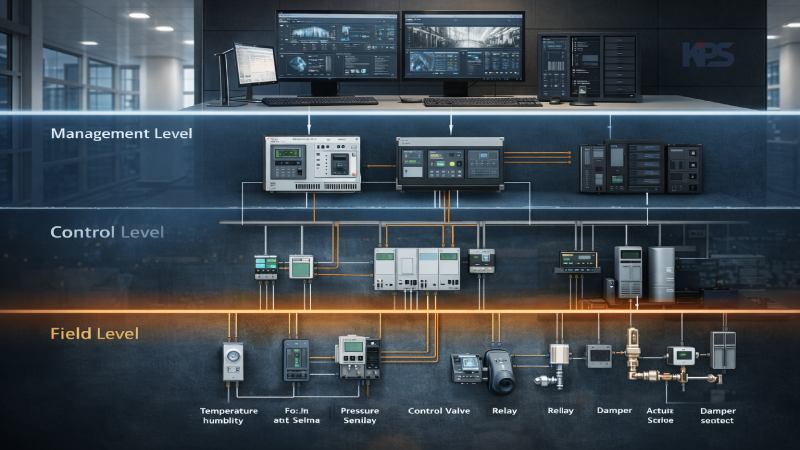
The core value of a Building Management System lies not in controlling individual systems, but in its ability to integrate and orchestrate all technical infrastructures on a centralized platform. Through this integration, BMS enables electromechanical systems to operate as a unified whole—optimizing performance, saving energy, and enhancing safety.
In most modern buildings, HVAC is the largest energy consumer, typically accounting for 40–60% of total electricity usage. Integrating HVAC into BMS allows for more precise and flexible control than manual operation. Specifically, BMS enables:
With real-time monitoring and operational data analysis, BMS also supports early detection of HVAC abnormalities, reducing equipment failure risks and maintenance costs.
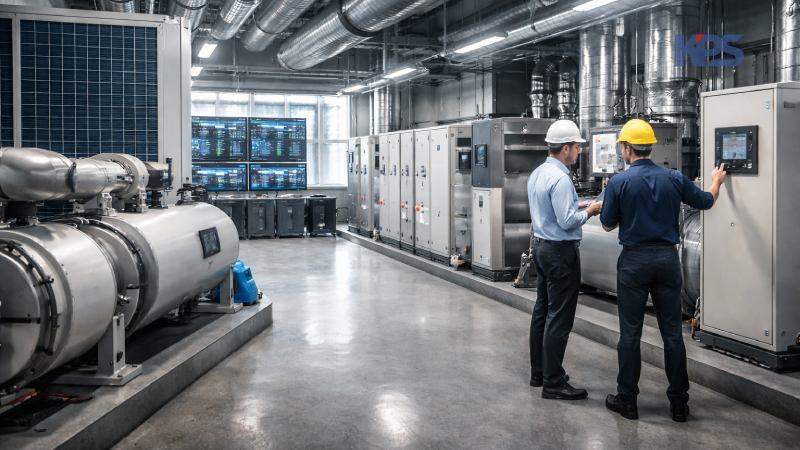
When integrated into BMS, lighting systems go beyond simple on/off control to become part of an overall energy management strategy. This reduces energy waste, extends equipment lifespan, and enhances user experience in offices, shopping centers, and hotels. BMS enables:
When integrated with security systems such as CCTV, access control, and alarm systems, BMS becomes a comprehensive safety monitoring platform that enhances security while reducing reliance on manual supervision.
Through BMS, building operators can:
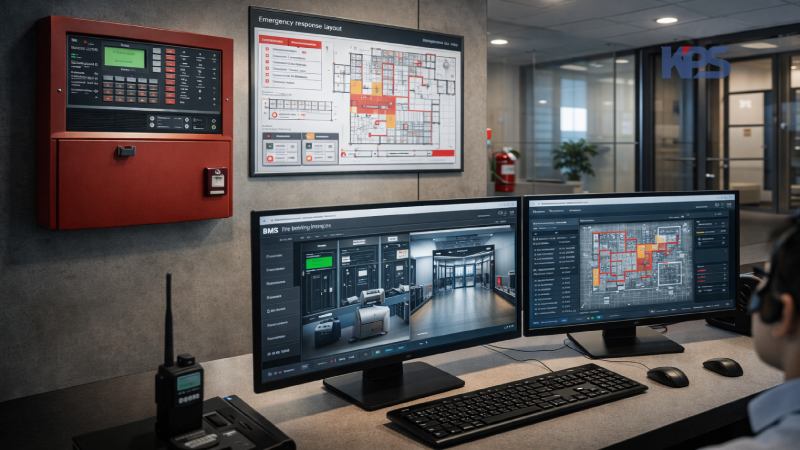
BMS plays a central role in connecting and coordinating fire protection systems with other technical infrastructures. This integration minimizes risk, reduces damage, and improves compliance with safety standards.
Upon receiving a fire alarm signal, BMS can:
Energy management is becoming a mandatory requirement as operational costs rise and ESG standards gain wider adoption. When integrated with EMS, BMS becomes an effective analytical and decision-support tool for building owners.
Specifically, BMS enables:
To enable connectivity and data exchange between different devices and systems, BMS relies on standardized communication protocols. The choice of protocol directly affects system integration and scalability.
BACnet (Building Automation and Control Network) is specifically developed for building automation and is currently the most widely used protocol in modern BMS.
Key advantages include:
Modbus is widely used in energy metering and industrial devices. Its characteristics include:
These protocols are commonly used for specialized systems:
They can be integrated into BMS via gateways to form a unified ecosystem.
One of the most tangible benefits of BMS is the reduction of overall operating costs through demand-based control and coordination of technical systems. BMS helps to:
In practice, BMS implementation can reduce energy costs by 10–30%, depending on building scale and integration level.
BMS enables real-time monitoring of all technical systems on a centralized platform, ensuring systems operate at the right capacity, at the right time, and according to actual demand.
Key benefits include:
Improper loading and continuous high-level operation are major causes of premature equipment degradation. BMS supports:
As a result, equipment lifespan is extended and maintenance and replacement costs are significantly reduced.
BMS contributes to a comfortable, stable, and intelligent indoor environment, improving productivity and user satisfaction. Specifically:
As ESG standards and green building requirements become increasingly important, BMS becomes an essential tool that enhances brand image and long-term asset value. BMS enables:
A building equipped with a modern BMS:
Implementing a BMS requires a structured process and close coordination among building owners, design consultants, MEP contractors, and system integrators. A standardized process ensures stable initial operation and determines long-term scalability and sustainability.
Typical BMS implementation steps include:
The development of smart cities, energy efficiency demands, and data-driven operations is transforming BMS from a traditional monitoring and control system into an intelligent, predictive, and self-optimizing management platform.
Rather than reacting to failures, next-generation BMS focuses on predictive maintenance to reduce operating costs and extend equipment lifespan.
IoT expands BMS connectivity to thousands of sensors and smart devices.
Role of Edge Computing:
Combined, IoT and Edge Computing enable BMS to:
Key advantages include:
Cloud does not fully replace on-premise systems, but is typically deployed in hybrid models to balance data security and performance.
Digital Twin represents the highest level of smart building management. BMS integrated with Digital Twin enables:
For building owners, Digital Twin enables data-driven decision-making rather than reliance on subjective experience.
KPS is a provider and system integrator of Building Management System (BMS) solutions in Vietnam, with a vision to develop synchronized, open, and sustainable technical infrastructure ecosystems for modern buildings. KPS goes beyond equipment distribution, focusing on end-to-end solutions that meet real operational needs, technical standards, and long-term scalability.
In the BMS domain, KPS collaborates with and deploys leading global platforms such as ABB, Genetec, CNB, Siemens, and Legrand, along with controllers, sensors, and management software compliant with open protocols such as BACnet, Modbus, KNX, and DALI. This ensures multi-vendor integration, flexibility across building types, and avoidance of proprietary technology lock-in.
Beyond BMS, KPS offers a comprehensive ecosystem of smart building and smart city solutions, including:
With a highly experienced engineering team specializing in design, integration, and operation, KPS partners with building owners, consultants, and contractors throughout the entire project lifecycle—from system architecture design and deployment to commissioning and long-term optimization. KPS’s goal is to enable efficient building operation, energy savings, and readiness for future digital transformation.
Explore KPS’s smart building solution ecosystem here.

Other news

Signify and KPS sign strategic partnership agreement.
Signify and KPS have signed a strategic partnership to promote smart, energy-efficient lighting solutions for buildings in Vietnam.
View detail

From APEC 2017 Da Nang to APEC 2027 Phu Quoc: From traditional security solutions to smart IOCs.
From APEC 2017 security monitoring solutions to a smart IOC model for APEC 2027 in Phu Quoc.
View detail

Team Building KPS 2026 | Da Nang - Hoi An - Hue
KPS 2026 Team Building journey in Da Nang - Hoi An - Hue, where teams bond, recharge, and spread sustainable values.
View detail

Optimizing air conditioning based on room conditions in hotels and resorts.
Why do 20-30% of hotel rooms still have their air conditioning running even when there are no guests?
View detail

Energy-saving solutions for hotels and resorts - without compromising the experience.
Consulting and implementing EMS systems for hotels - reducing electricity costs, smarter operation - without compromising customer experience.
View detail

Energy Management System (EMS): Cost and Operation Optimization
EMS solutions help businesses monitor, analyze, and optimize energy in real time, saving 10-30% on electricity costs.
View detail
ABOUT KPS


Regulations and policies
Warranty and return policy Delivery, payment, and feedback Giấy phép kinh doanhContact Information
HO CHI MINH OFFICE
10–12 Dong Van Cong Street, Cat Lai Ward, Ho Chi Minh City.
+842839976099 / 903 709 019
info@kps.com.vn
www.kps.com.vn
Work time
Monday – Friday : 8:00 AM - 17:30 PM
Saturday - Sunday: Off
HA NOI OFFICE
22 Alley 168 Nguyen Xien, Khuong Dinh Ward, Hanoi City
+84 903 709 019
kpshn@kps.com.vn
www.kps.com.vn
Work time
Monday – Friday: 8:00 AM - 17:30 PM
Saturday - Sunday: Off
DA NANG OFFICE
490 Nguyen Tri Phuong, Hoa Cuong Ward, Da Nang City
+84 903 709 019
kpsdn@kps.com.vn
www.kps.com.vn
Work time
Monday – Friday: 8:00 AM - 17:30 PM
Saturday - Sunday: Off
CAN THO OFFICE
11/11 Tran Binh Trong, Ninh Kieu Ward, Ninh Kieu District, Can Tho City.
+84 090 709 019
kpsct@kps.com.vn
www.kps.com.vn
Work time
Monday – Friday: 8:00 AM - 17:30 PM
Saturday - Sunday: Off
SERVICE CENTER - WAREHOUSE
10–12 Dong Van Cong Street, Cat Lai Ward, Ho Chi Minh City.
+ 84 28 3997 0609
baohanh@kps.com.vn
www.kps.com.vn
Work time
Monday – Friday: 8:00 AM - 17:30 PM
Saturday - Sunday: Off
2010 © Bản quyền thuộc KPS
Online: 43 | Visitors Counter: 14874910
About | Recruitment | News | Contact Us


