


info@kps.com.vn
+84 903 709 019
A Data Center (DC) is the central location that houses all servers, storage systems, and mission-critical infrastructure of an organization. Even a minor incident — power loss, temperature spike, or unauthorized access to the server room — can cause hours of downtime, data loss, or catastrophic system failures.
Because of this, physical security in a Data Center must meet strict standards: high-security cameras, multi-layer access control, AI-driven anomaly detection, and continuous 24/7 environmental and fire monitoring.
This article provides a detailed guide to end-to-end security monitoring solutions for Data Centers, based on real-world requirements and international standards such as ISO 27001, TIA-942, and Uptime Tier III–IV.
Unlike typical buildings, Data Centers have many unique characteristics that require extremely high security levels.
Every person entering the server room must have a valid reason, and all entries must be logged.
A standard-compliant DC requires:
Multi-factor authentication (card + biometrics)
Camera coverage of 100% of the area
No blind spots
Automatic intrusion alarms
24/7 operation without downtime
Servers run 24/7, which means cameras, access control systems, and sensors must also run 24/7.
Even a few seconds of video loss or access control failure can lead to serious security risks.
Video footage from server rooms is highly sensitive → cameras must have strong encryption and be tamper-proof.
Thus, Data Centers typically require:
FIPS 140-2 certified cameras
IT infrastructure compliant with IEC/ISO standards
Minimum 90–180 days of video retention
Data Centers contain:
Heat-sensitive equipment
High power density
Fiber cabling
UPS and battery systems
Therefore, real-time monitoring of temperature, humidity, smoke, gas, water leakage, and rack door status is mandatory.
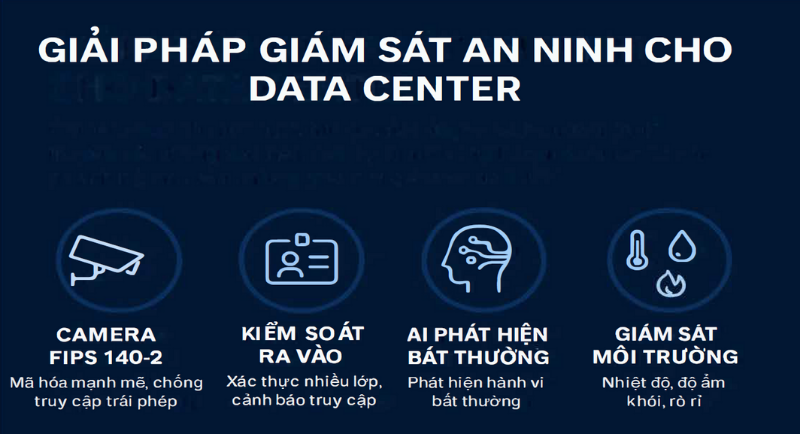
FIPS 140-2 (Federal Information Processing Standard 140-2) is a cryptographic security standard issued by NIST (National Institute of Standards and Technology, USA).
It is mandatory for IT systems within U.S. government agencies and organizations requiring high-level data protection (finance, defense, critical infrastructure).
Devices certified under FIPS 140-2 must:
Encrypt video data using AES-256
Prevent unauthorized access
Prevent video stream hijacking
Protect firmware against tampering or malware injection
This is why most Tier III–IV Data Centers require FIPS-certified cameras.
In Data Centers, cameras are not only security devices but also network endpoints vulnerable to cyberattacks. FIPS-certified cameras mitigate these risks through enhanced physical and cryptographic protection:
Using FIPS-validated algorithms (AES-256, TLS) to encrypt:
Video
Audio
Metadata
both in transit and at rest.
This prevents interception, spoofing, or manipulation of critical footage.
Higher FIPS levels (Level 3–4) require:
Tamper detection
Automatic erasure of cryptographic parameters if the device is physically compromised
Prevention of unauthorized firmware installation
Only authorized users and systems can access or manage the camera.
If cameras are the “eyes,” access control is the “gatekeeper” of the Data Center.
Access Control in a DC must not only open/close doors but also:
Log every action
Verify identity
Enforce authorization
Trigger alarms
Share synchronized data with CCTV and AI analytics
Most common for general staff — easy to manage and assign access rights.
Provides higher accuracy and reduces credential spoofing.
Such as:
Palm vein
Iris scan
Vascular pattern recognition
These are used for highly sensitive areas like core network rooms.
Control physical access to each server rack with logging.
Combining:
Card + Biometrics
Card + PIN
Face ID + Rack access
Suitable for Tier III–IV Data Centers.
When someone authenticates at the door:
Access control logs the card ID/user information
Camera captures the person at the exact timestamp
The system automatically matches:
User ID + Name + Time + Location + Actual Image
AI compares the captured face with the registered identity
If mismatch → alert is triggered immediately
This prevents credential sharing or unauthorized access.
AI analyzes real-time video to detect security incidents:
Two people entering with one authentication.
AI counts people → detects surplus → triggers alarm.
Moving in restricted directions
Entering unauthorized zones
Staying too long near a rack or door
Looking around
Waiting near access points
Examining cameras or systems
Even valid users can trigger alerts if access occurs outside permitted schedules.
System checks:
Who opened the rack?
Were they authorized?
Does it match maintenance schedule?
Non-registered individuals appearing near doors or inside server rooms trigger immediate alerts to NOC/SOC.
Over 70% of DC failures come from environmental issues, not external attacks.
Thus, real-time monitoring is mandatory.
A 3–5°C rise can cause server crashes or reduce component lifespan.
Too low → static electricity
Too high → condensation, short circuits
Early fire and electrical hazard detection.
From cooling systems, CRAC units, or chilled water pipelines.
Unauthorized opening triggers immediate alarms.
Voltage drop
Phase loss
UPS bypass
Battery degradation
Ensures cold aisle containment and cooling efficiency.
Common clean agents:
FM-200 (HFC-227ea)
Novec 1230 (FK-5-1-12)
Both are ideal for IT environments.
Non-conductive → safe for electronics
Fast discharge (≈10 seconds)
Human-safe at correct concentrations
Environmentally friendly (Novec: very low GWP)
Compact storage (FM-200)
Sensors transmit data to controllers or edge gateways → to DCIM/BMS or security systems.
Each sensor has:
Normal
Warning
Critical thresholds
System classifies events based on severity.
Sent to:
Dashboard
Mobile app
Email / SMS / Call
Automatic actions may include activating cooling or fire suppression.
All events are stored for analysis and auditing.
Operators confirm alarms and act according to SOP.
Bosch Building Integration System (BIS) is a unified platform integrating:
Access Control
Fire Detection
Intrusion Alarm
CCTV
Emergency communication
Building system interfaces (BMS/SCADA)
BIS provides a centralized web-based console for complete security oversight.
Access control with Bosch AMC controllers
Fire alarm systems (FPA series)
Video surveillance
Intrusion detection (MAP 5000)
Public address / EVAC systems
OPC integration for building systems
Interactive floor plans
Alarm workflows and priority levels
Automatic actions (e.g. lock doors, trigger announcements)
Full event/operation logs
SDK/API for AI and third-party integration
Faster incident response
Scalable architecture for expanding Data Centers
Strong integrations with DCIM, BMS, and AI analytics
High reliability and security designed for 24/7 environments
Other news

Signify and KPS sign strategic partnership agreement.
Signify and KPS have signed a strategic partnership to promote smart, energy-efficient lighting solutions for buildings in Vietnam.
View detail

From APEC 2017 Da Nang to APEC 2027 Phu Quoc: From traditional security solutions to smart IOCs.
From APEC 2017 security monitoring solutions to a smart IOC model for APEC 2027 in Phu Quoc.
View detail

Team Building KPS 2026 | Da Nang - Hoi An - Hue
KPS 2026 Team Building journey in Da Nang - Hoi An - Hue, where teams bond, recharge, and spread sustainable values.
View detail

Optimizing air conditioning based on room conditions in hotels and resorts.
Why do 20-30% of hotel rooms still have their air conditioning running even when there are no guests?
View detail

Energy-saving solutions for hotels and resorts - without compromising the experience.
Consulting and implementing EMS systems for hotels - reducing electricity costs, smarter operation - without compromising customer experience.
View detail

Energy Management System (EMS): Cost and Operation Optimization
EMS solutions help businesses monitor, analyze, and optimize energy in real time, saving 10-30% on electricity costs.
View detail
ABOUT KPS


Regulations and policies
Warranty and return policy Delivery, payment, and feedback Giấy phép kinh doanhContact Information
HO CHI MINH OFFICE
10–12 Dong Van Cong Street, Cat Lai Ward, Ho Chi Minh City.
+842839976099 / 903 709 019
info@kps.com.vn
www.kps.com.vn
Work time
Monday – Friday : 8:00 AM - 17:30 PM
Saturday - Sunday: Off
HA NOI OFFICE
22 Alley 168 Nguyen Xien, Khuong Dinh Ward, Hanoi City
+84 903 709 019
kpshn@kps.com.vn
www.kps.com.vn
Work time
Monday – Friday: 8:00 AM - 17:30 PM
Saturday - Sunday: Off
DA NANG OFFICE
490 Nguyen Tri Phuong, Hoa Cuong Ward, Da Nang City
+84 903 709 019
kpsdn@kps.com.vn
www.kps.com.vn
Work time
Monday – Friday: 8:00 AM - 17:30 PM
Saturday - Sunday: Off
CAN THO OFFICE
11/11 Tran Binh Trong, Ninh Kieu Ward, Ninh Kieu District, Can Tho City.
+84 090 709 019
kpsct@kps.com.vn
www.kps.com.vn
Work time
Monday – Friday: 8:00 AM - 17:30 PM
Saturday - Sunday: Off
SERVICE CENTER - WAREHOUSE
10–12 Dong Van Cong Street, Cat Lai Ward, Ho Chi Minh City.
+ 84 28 3997 0609
baohanh@kps.com.vn
www.kps.com.vn
Work time
Monday – Friday: 8:00 AM - 17:30 PM
Saturday - Sunday: Off
2010 © Bản quyền thuộc KPS
Online: 21 | Visitors Counter: 15513942
About | Recruitment | News | Contact Us


.png)


