


info@kps.com.vn
+84 903 709 019
Are you facing these problems?
If you are looking for:
Then this article will guide you from understanding → choosing → implementing the right solution.
In modern facilities in Vietnam such as office buildings, shopping malls, hospitals, or 24/7 manufacturing plants, HVAC systems account for 40-60% of total energy consumption.
The core issue is not the equipment - but how it is operated:
As a result:
Learn more about how buildings waste energy and comprehensive optimization solutions in the article: Energy-saving solutions to reduce building operating costs.
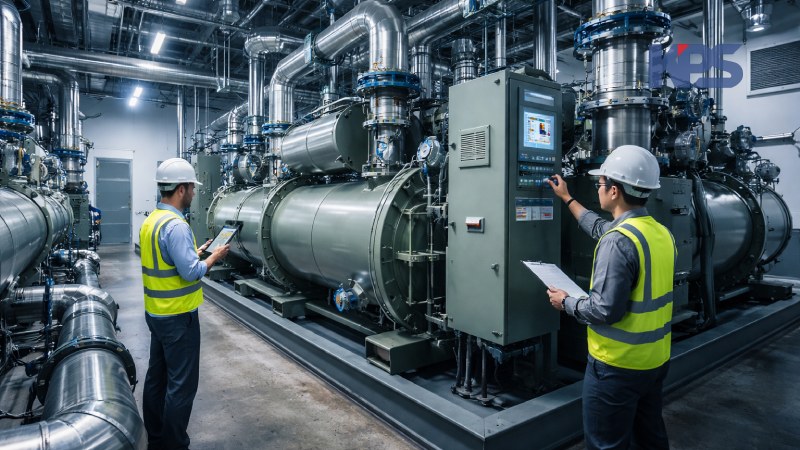
Modern HVAC no longer operates independently, but becomes part of the Smart Building ecosystem.
In the context of HVAC energy optimization, instead of operating separately, BMS (Building Management System) helps businesses connect - monitor - optimize the entire HVAC system on a single platform.
BMS collects data from HVAC equipment (Chiller, AHU, FCU, VRV/VRF...), analyzes real-time operating status, and automatically controls the system based on programmed scenarios.
Modern platforms from Legrand, ABB also allow:
Simply put, BMS transforms HVAC from “schedule-based operation” → “demand-based operation.”
In modern buildings, HVAC systems no longer just “react” to settings, but can learn - adapt - predict.
How do AI & IoT help save energy?
Demand-based HVAC means system capacity is adjusted based on real-time demand in each area.
How does it save energy?
Among HVAC energy-saving solutions, if you need one that is easy to implement - cost-effective - delivers immediate results, it is:
Variable Speed Drive (VSD/Inverter) combined with load optimization
VSD adjusts motor speed based on actual demand.
Without VSD, traditional systems operate as: ON = 100% capacity / OFF = 0%
This leads to energy waste, equipment wear, and unstable temperature control.
In reality, VSD is just a “tool” - load optimization is the “strategy.”
Load optimization means:
Common optimization strategies:
A common question: Do we need to replace the entire HVAC system?
The answer: No.
Effective implementation roadmap:
This approach ensures cost efficiency and measurable results at each stage.

In today’s context of increasing operational cost pressure and sustainability standards, choosing an HVAC provider is not just about equipment, but about a partner who can:
Understand the system - Optimize holistically - Support long-term
KPS approaches HVAC through Integrated Solutions.
KPS HVAC Solution: From standalone systems → Integrated ecosystem
Electrical & Smart Building systems
Solutions from Legrand, ABB form the backbone:
ICT infrastructure
Security monitoring systems
Notification & operation systems
Fire protection systems
In modern HVAC, the key is not the best equipment, but: The ability to integrate and optimize the entire system
With its integrated ecosystem and proven implementation capability, KPS helps businesses:
Are you paying daily for wasted HVAC energy?
Contact KPS today to find the optimal solution.

Other news

Signify and KPS sign strategic partnership agreement.
Signify and KPS have signed a strategic partnership to promote smart, energy-efficient lighting solutions for buildings in Vietnam.
View detail

From APEC 2017 Da Nang to APEC 2027 Phu Quoc: From traditional security solutions to smart IOCs.
From APEC 2017 security monitoring solutions to a smart IOC model for APEC 2027 in Phu Quoc.
View detail

Team Building KPS 2026 | Da Nang - Hoi An - Hue
KPS 2026 Team Building journey in Da Nang - Hoi An - Hue, where teams bond, recharge, and spread sustainable values.
View detail

Optimizing air conditioning based on room conditions in hotels and resorts.
Why do 20-30% of hotel rooms still have their air conditioning running even when there are no guests?
View detail

Energy-saving solutions for hotels and resorts - without compromising the experience.
Consulting and implementing EMS systems for hotels - reducing electricity costs, smarter operation - without compromising customer experience.
View detail

Energy Management System (EMS): Cost and Operation Optimization
EMS solutions help businesses monitor, analyze, and optimize energy in real time, saving 10-30% on electricity costs.
View detail
ABOUT KPS


Regulations and policies
Warranty and return policy Delivery, payment, and feedback Giấy phép kinh doanhContact Information
HO CHI MINH OFFICE
10–12 Dong Van Cong Street, Cat Lai Ward, Ho Chi Minh City.
+842839976099 / 903 709 019
info@kps.com.vn
www.kps.com.vn
Work time
Monday – Friday : 8:00 AM - 17:30 PM
Saturday - Sunday: Off
HA NOI OFFICE
22 Alley 168 Nguyen Xien, Khuong Dinh Ward, Hanoi City
+84 903 709 019
kpshn@kps.com.vn
www.kps.com.vn
Work time
Monday – Friday: 8:00 AM - 17:30 PM
Saturday - Sunday: Off
DA NANG OFFICE
490 Nguyen Tri Phuong, Hoa Cuong Ward, Da Nang City
+84 903 709 019
kpsdn@kps.com.vn
www.kps.com.vn
Work time
Monday – Friday: 8:00 AM - 17:30 PM
Saturday - Sunday: Off
CAN THO OFFICE
11/11 Tran Binh Trong, Ninh Kieu Ward, Ninh Kieu District, Can Tho City.
+84 090 709 019
kpsct@kps.com.vn
www.kps.com.vn
Work time
Monday – Friday: 8:00 AM - 17:30 PM
Saturday - Sunday: Off
SERVICE CENTER - WAREHOUSE
10–12 Dong Van Cong Street, Cat Lai Ward, Ho Chi Minh City.
+ 84 28 3997 0609
baohanh@kps.com.vn
www.kps.com.vn
Work time
Monday – Friday: 8:00 AM - 17:30 PM
Saturday - Sunday: Off
2010 © Bản quyền thuộc KPS
Online: 25 | Visitors Counter: 17802239
About | Recruitment | News | Contact Us


