


info@kps.com.vn
+84 903 709 019
Did you know: A 4K camera using an outdated compression standard can "consume" up to 240GB of storage/day - equivalent to a 2TB hard drive that can only store 8 days? Meanwhile, H.265+ technology helps reduce this number to 45GB, extending storage time by 5 times! This article will compare in detail the 3 "final bosses" in the video compression village: H.264, H.265 and H.265+, helps you choose the optimal compression standard to save 70% of the cost of investing in a camera system!
The Video Compression Standard is a standardized set of rules and algorithms to reduce the size of video files while still trying to keep the image quality at an acceptable level. The main purpose is to make storage, transmission and processing video becomes more efficient and feasible.
Raw video data is extremely large: An uncompressed video (e.g. Full HD 1080p resolution, 30 frames/second) can require bandwidth of hundreds of Mbps to Gbps and huge storage capacity. This is almost impossible with network infrastructure and normal hard drive.
Reduce network bandwidth: Helps transmit video over the network (Internet, internal network) smoothly, without lag, even on low bandwidth lines.
Save storage space: Allows storage of hours, days, months of video on hard drive or cloud at a reasonable cost.
Reduce processing requirements: Smaller compressed data means less decoding (review) also consumes less CPU/GPU resources.
Video compression standards work by eliminating redundant information in video data. There are two main types of redundancy:
Spatial Redundancy: Adjacent pixels in the same frame are often very similar (e.g. a white wall).
Solution: Instead of storing each pixel individually, compress in blocks and only store the differences between pixels within the block (using transforms like DCT - Discrete Cosine Transform).
Temporal Redundancy: Consecutive frames are often very similar (e.g., an empty room scene with no people moving around).
Solution: Only store some key frames (I-frames) in full. The following frames are in the form of difference from the previous frame (P-frame) or previous/next frame (B-frame), using Motion Estimation & Compensation to find similar blocks between frames.
Lossless Compression: Recovers 100% of original data after decompression. Low compression ratio, not suitable suitable for real video (e.g. ZIP file).
Lossy Compression: Accepts the loss of some insignificant or unimportant information to achieve a high compression ratio. Most video compression standards (H.264, H.265, MPEG-2) are of this type. The quality depends on the "loss" (bitrate).
MJPEG (Motion JPEG): Frame-by-frame compression individual images like JPEG. High capacity, good quality per frame, but does not take advantage of redundant time.
MPEG-4 Part 2: Predecessor of H.264, better compression ratio than MJPEG.
H.264 / AVC (Advanced Video Coding): Extremely popular standard, good balance between quality, compression ratio and processing capabilities.
H.265 / HEVC (High Efficiency Video Coding): Next generation, compresses 30-50% more efficiently than H.264 at the same quality, optimized for 4K/8K video.
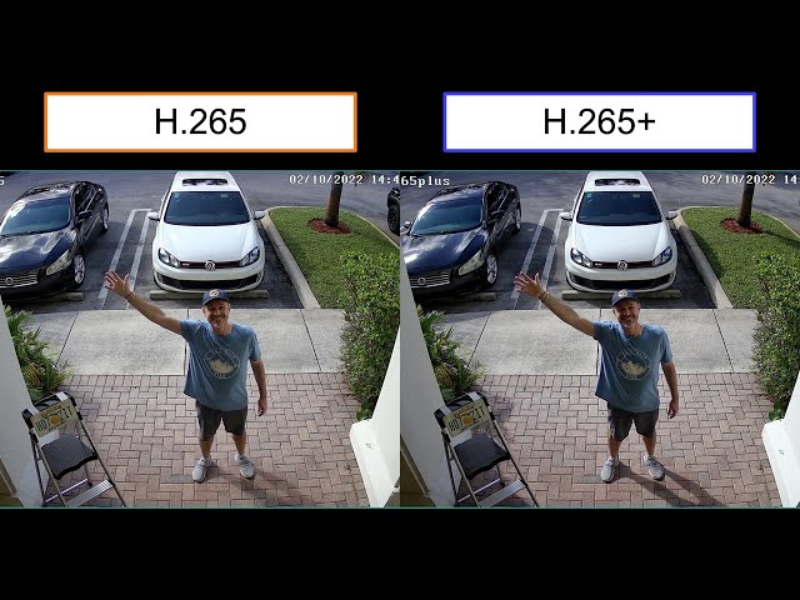
H.265+/HEVC+/Smart Codec: Proprietary enhanced version based on H.265 of the g camera, using smart techniques (ROI, bitrate/fps adjustment) to compress even more efficiently (70-90% savings compared to H.264).
AV1: New, open source compression standard, more efficient than HEVC, but requires high processing and not widely used in cameras.
Cameras often record continuously 24/7, creating a huge amount of video data.
The need for long-term storage (weekly, monthly).
The need to transmit multiple video streams simultaneously over the network (to recorders, phones, storage and network bandwidth budgets are always limited.
Efficient compression standards (such as H.265, H.265+) are key to addressing these challenges: significantly reducing costs storage, network offload, allowing the practical use of high-resolution cameras (4K, 8MP).
Year of birth: 2003 (Popular since ~2008)
Goal: Replace MPEG-2, better compression for HD (1080p).
Main technology:
Divide the frame into 16x16 pixel macroblocks.
Complex Motion Estimation/Compensation.
4x4 integer transformation (Integer Transform).
Mã entropy encoding CAVLC (Context-Adaptive Variable-Length Coding) or CABAC (Context-Adaptive Binary Arithmetic Coding - more efficient but resource-intensive).
Advantages:
Widely available: Supported on most devices (phones, TVs, computers, browsers, old IP cameras).
Good compatibility: Easy to playback, stream.
Better compression efficiency than older standards (MPEG-2, DivX): Reduces bitrate by ~50% for the same quality.
Disadvantages:
Bandwidth & Storage: Requires large bandwidth/storage for high-definition video (4K, 8K).
Compression efficiency: Significantly less efficient than H.265/HEVC.
Applications: Streaming (YouTube, Netflix - previously), Blu-ray, HDTV broadcast, video call, general IP cameras.
Year of birth: 2013 (Popular since ~2016)
Goal: Reduce bitrate by ~50% compared to H.264 at the same quality, support 4K/8K, HDR.
Main technology (Improved from H.264):
CTU (Coding Tree Units): Replace macroblock. CTU is more flexible (size from 64x64 to 16x16), divided into CUs (Coding Units), PUs (Prediction Units), TUs (Transform Units).
Intra Prediction: More prediction directions (35 directions compared to 9 of H.264).
Motion prediction: Support parallel processing, more accurate motion vectors.
Transform: Larger transformation size (up to 32x32).
Entropy Maã: Mainly uses optimized CABAC.
SAO (Sample Adaptive Offset): New post-processing filter that reduces block noise and improve quality.
Advantages:
Superior compression efficiency: Save 40-50% bandwidth/storage compared to H.264 at the same quality.
High resolution support: Optimized for 4K (UHD), 8K, HDR, 360° video.
Better image quality: At the same bitrate, the image is sharper, less block noise than H.264.
Disadvantages:
High computational complexity: Requires more powerful hardware for encoding and decoding (compared to H.264).
Complex copyright issues: May result in higher copyright costs for publishers production.
Hardware support/time required: Older devices do not support HEVC hardware decoding.
Applications: 4K streaming (YouTube, Netflix, Amazon Prime), UHD Blu-ray, high-definition IP cameras (4K+), surveillance systems that require storage savings, VR/360 video.
Nature: Not a new compression standard (like H.264 or H.265). This is an extension solution or optimization technology based on the H.265/HEVC platform, developed mainly by surveillance camera and network equipment manufacturers (Hikvision, Dahua, Uniview...).
Objectives: Saving bandwidth and more storage capacity (compared to normal H.265), especially for 24/7 surveillance camera systems.
Key Technologies (Usually Include):
Advanced VBR Optimization (Smart VBR/VBR+): More flexible bitrate adjustment based on:
Scene Analysis: Motion detection, lighting changes, scene complexity.
Reducing frames Smart Frame Reduction: Automatically reduces frame rate (FPS) when the scene is static or has little motion (e.g. from 25fps to 5fps), and increases it again when there is significant motion. This is the key to saving money.
ROI (Region of Interest) optimization: Prioritizes quality for important regions (people, vehicles) and reduce bitrate for less important areas (background, sky).
Smart pre/post-processing technology: Noise filtering, detail enhancement before matting or after demapping to maintain quality at low bitrate.
Advantages:
Extremely good storage & bandwidth savings: Yes can save an additional 30-70% compared to conventional H.265, and up to 80-90% compared to H.264 (as advertised by the manufacturer, under ideal conditions).
Ideal for 24/7 surveillance: Optimized for continuous video streaming, especially when the scene is mostly static.
Disadvantages:
Not a common standard: Each brand has its may implement proprietary technology -> Poor compatibility. H.265+ video is typically best played back only on the manufacturer's own device/NVR or dedicated software. Playback on a regular player may be buggy.
Risk of loss of detail/quality: Harsh FPS drops during static scenes may cause loss of small movements. Excessive bitrate drops in "non-critical" areas may can lose background detail when necessary.
Potential latency: Scene analysis and parameter adjustment may cause a small delay.
Hardware requirements: Requires camera and NVR supports H.265+ technology of the same brand.
Main application: IP surveillance camera system, especially when requiring long-term video storage (monthly) with multiple high-resolution camera channels without consuming too many hard drives.
| Features | H.264 / AVC | H.265 / HEVC | H.265+ / HEVC+ |
|---|---|---|---|
| Popular year | ~2008 | ~2016 | ~2018 (mainly in surveillance) |
| Compression efficiency | Baseline | ~40-50% better than H.264 | Also (30-70%) better than H.265 |
| Bitrate | Highest | Medium (≈50% H.264) | Lowest (≈50% H.265) |
| Optimal Resolution | HD (1080p) | 4K (UHD), 8K, HDR | 4K+ (Monitoring) |
| Complexity | Medium average | High(Encoding/Decoding) | Very High(Adds AI, analytics) |
| CPU/GPU load | Lower than HEVC | Higher than AVC | Highest (especially when encoding) |
| Copyright | Clear, popular | Complex,can be expensive | Depends on the house production |
| Compatibility | Excellent(Almost everywhere) | Good(Common on new devices) | Poor(Usually only in the product ecosystem) |
| Main Applications | HD Streaming, Conferencing, Legacy IP Cameras | 4K Streaming, UHD Blu-ray, 4K IP Cameras | IP Surveillance Cameras(save storage storage) |
Choosing the right compression standard for your surveillance camera system is an important decision that directly affects performance, cost and future scalability. Here are some guidelines to help you make the optimal choice between H.264, H.265 and H.265+:
H.264 is still the a reliable and popular choice in many cases, especially if you have budget constraints or an existing system.
You want to save on initial investment costs: Cameras and recorders that only support H.264 are often more affordable. If your budget is limited, this may be the most economical option.
Your existing system is H.264: If you are looking to upgrade or expand an existing H.264 surveillance system, staying with this standard will ensure the highest compatibility between old and new equipment.
Resolution requirements are not too high: For lower resolution cameras (e.g., below 2MP or just 1080p at an acceptable bitrate), H.264 still provides good compression performance and enough.
Network bandwidth and storage are not too big of an issue: If you have enough stable network bandwidth and plenty of storage, or only need short-term storage, H.264 is still a reasonable choice.
H.265 is a big step forward in compression efficiency, suitable for new systems or when you want to get the most out of image quality and save resources.
You use high-resolution cameras (4MP, 5MP, 4K or higher): This is the most outstanding advantage of H.265. With the same image quality, H.265 can reduce 50% bandwidth and storage capacity compared to H.264. This is extremely important when you want to deploy super-sharp cameras.
You want to optimize network bandwidth: If your system has large number of cameras, or limited network connection, H.265 will help reduce the load on the network significantly, minimizing lag.
You want to extend the storage time: By reducing the size of video files, H.265 allows you to store video for a longer time on the same hard drive capacity, saving storage costs in the long term.
You are willing to invest in newer hardware: Cameras and recorders that support H.265 often require more powerful processing chips, so may cost a little more than H.264. However, this investment will be offset by bandwidth and storage savings.
You're building a new surveillance system: This is a good opportunity to deploy H.265 from the start, taking advantage of the benefits this compression standard offers.
H.265+ is The best choice for large-scale, professional surveillance systems, especially when the requirement for resource saving is extremely high.
You have a large-scale surveillance system with many cameras: H.265+ can reduce data by 30-70% compared to H.265. With hundreds or thousands of cameras, this saving becomes huge, helping to reduce network infrastructure costs and incredible storage.
You use ultra-high resolution cameras and need very long storage: When combining 4K/8K cameras with storage requirements of several weeks or months, H.265+ is the best choice for managing large-scale data.giant.
Most surveillance scenes are static (little movement): H.265+ is most effective thanks to its intelligent optimization in static scenes, compressing only the details of moving objects. This is very common in areas such as offices, hallways, parking lots, etc.
You commit to using equipment from the same manufacturer: Since H.265+ is proprietary technology of each brand (e.g. Hikvision's H.265+, Dahua's Smart H.265), you need to ensure that both the camera and the recorder support and are compatible with this technology to achieve maximum efficiency.
You have the budget to invest in high-end hardware: Although it brings great benefits in the long run, hardware that supports H.265+ is often more expensive due to the processing chip required more powerful to run complex intelligent algorithms.
Choosing and effectively using compression standards such as H.264, H.265, or H.265+ is a key factor in optimizing your surveillance camera system. However, to ensure the system operates stably and effectively, you need to note the following important points:
Most Important: This is the top factor. If you buy a camera that supports H.265 but the recorder (NVR/DVR) only supports H.264, you will not be able to take advantage of the benefits of H.265. The camera will automatically switch to a lower compression standard (H.264) or is not fully compatible.
Brand synchronization (for H.265+): For proprietary optimized compression standards such as H.265+ (by Hikvision) or Smart H.265 (by Dahua), to achieve the highest compression efficiency, it is best to use synchronization of both the camera and the recorder from the same manufacturer that supports that technology. Although This brand's cameras may run on other brands' recorders, but the deep optimization features of H.265+ may not be fully functional.
H.265 and H.265+ are more demanding: Although they save bandwidth and storage, encoding and decoding H.265 and H.265+ video requires more processing power from the camera chip and especially the NVR/DVR.
Cost Impact: Devices that support H.265/H.265+ effectively often have more powerful chips, which can result in a slightly higher initial cost than devices that only support H.264. Make sure your NVR has enough processing power to record multiple H.265/H.265+ video streams simultaneously at high resolution without stuttering or missing frames.
Trade-off between quality and size: Lossy compression standards always have a trade-off between image quality and file size (or bitrate). The lower the bitrate, the smaller the file, but the image quality is may degrade and artifacts such as noise and artifacts may appear.
Appropriate settings: You need to set the bitrate and frame rate to suit your actual monitoring needs.
Bitrate:
Higher bitrate = Better image quality, but takes up more space and more bandwidth.
Lower Bitrate = Smaller Capacity, saves bandwidth, but reduces image quality.
Frame Rate:
25/30 FPS (frames per second): Standard for smooth video, suitable for areas with a lot of movement.
10-15 FPS: Usually enough for areas with little movement, saves significant capacity.
CBR and VBR Modes:
CBR (Constant Bit Rate): Bitrate is kept at a roughly constant level. Size is predictable, but quality may decrease in complex scenes.
VBR (Variable Bit Rate): Bitrate will vary depending on scene complexity (increases for more motion, decreases for stillness). Usually gives better quality for the same average size.
Static vs. Dynamic:
H.265+ is extremely effective in static surveillance scenes where there is little movement (e.g. nighttime parking, empty hallways). It will reduce the bitrate to very low levels.
However, in dynamic scenes In situations where there is a lot of continuous movement (e.g. crowded streets, shops with lots of customers), the benefit of H.265+ over H.265 may not be too obvious, because the optimization algorithm will not have much redundant data to remove.
Image complexity: Images with a lot of details, complex colors, and graininess will be more difficult to compress and require higher bitrates to maintain quality.
Calculate Carefully: While new compression standards offer significant savings, you still need to carefully calculate the amount of hard drive space you need based on the number of cameras, resolution, frame rate, and desired storage time. There are Many online capacity calculators help with this.
Backup Plan: Even with large capacities, regular backups of important data are necessary to prevent the risk of data loss due to device failure.
Stay Up to Date: Manufacturers regularly release firmware updates for cameras and DVR to improve compression performance, fix bugs, and add new features. Regular updates will help your system operate stably and optimally.
Review software: Make sure the review software on your computer or mobile application is also updated to support the latest compression standards, helping to review videos smoothly and without errors.
Other news

Signify and KPS sign strategic partnership agreement.
Signify and KPS have signed a strategic partnership to promote smart, energy-efficient lighting solutions for buildings in Vietnam.
View detail

From APEC 2017 Da Nang to APEC 2027 Phu Quoc: From traditional security solutions to smart IOCs.
From APEC 2017 security monitoring solutions to a smart IOC model for APEC 2027 in Phu Quoc.
View detail

Team Building KPS 2026 | Da Nang - Hoi An - Hue
KPS 2026 Team Building journey in Da Nang - Hoi An - Hue, where teams bond, recharge, and spread sustainable values.
View detail

Optimizing air conditioning based on room conditions in hotels and resorts.
Why do 20-30% of hotel rooms still have their air conditioning running even when there are no guests?
View detail

Energy-saving solutions for hotels and resorts - without compromising the experience.
Consulting and implementing EMS systems for hotels - reducing electricity costs, smarter operation - without compromising customer experience.
View detail

Energy Management System (EMS): Cost and Operation Optimization
EMS solutions help businesses monitor, analyze, and optimize energy in real time, saving 10-30% on electricity costs.
View detail
ABOUT KPS


Regulations and policies
Warranty and return policy Delivery, payment, and feedback Giấy phép kinh doanhContact Information
HO CHI MINH OFFICE
10–12 Dong Van Cong Street, Cat Lai Ward, Ho Chi Minh City.
+842839976099 / 903 709 019
info@kps.com.vn
www.kps.com.vn
Work time
Monday – Friday : 8:00 AM - 17:30 PM
Saturday - Sunday: Off
HA NOI OFFICE
22 Alley 168 Nguyen Xien, Khuong Dinh Ward, Hanoi City
+84 903 709 019
kpshn@kps.com.vn
www.kps.com.vn
Work time
Monday – Friday: 8:00 AM - 17:30 PM
Saturday - Sunday: Off
DA NANG OFFICE
490 Nguyen Tri Phuong, Hoa Cuong Ward, Da Nang City
+84 903 709 019
kpsdn@kps.com.vn
www.kps.com.vn
Work time
Monday – Friday: 8:00 AM - 17:30 PM
Saturday - Sunday: Off
CAN THO OFFICE
11/11 Tran Binh Trong, Ninh Kieu Ward, Ninh Kieu District, Can Tho City.
+84 090 709 019
kpsct@kps.com.vn
www.kps.com.vn
Work time
Monday – Friday: 8:00 AM - 17:30 PM
Saturday - Sunday: Off
SERVICE CENTER - WAREHOUSE
10–12 Dong Van Cong Street, Cat Lai Ward, Ho Chi Minh City.
+ 84 28 3997 0609
baohanh@kps.com.vn
www.kps.com.vn
Work time
Monday – Friday: 8:00 AM - 17:30 PM
Saturday - Sunday: Off
2010 © Bản quyền thuộc KPS
Online: 35 | Visitors Counter: 17758772
About | Recruitment | News | Contact Us


