KPS System Corp | Công ty cổ phần Hệ Thống An Ninh Khai Phát

Camera with salt water corrosion resistant housing

In coastal areas, seaports, islands, factories near the sea, or seaside resorts, the environment is constantly exposed to salt spray, high humidity, and harsh weather conditions—factors that easily corrode and damage electronic equipment. That’s why cameras with salt-corrosion-resistant housings have become an indispensable choice in professional outdoor security systems.

An overview of the importance and challenges of corrosion-resistant cameras in marine environments

The importance of security monitoring in coastal areas, seaports, and industrial zones near the sea

Coastal areas, seaports, and industrial zones near the sea are often hubs for key economic activities such as freight transportation, resource extraction, industrial production, and marine tourism. These areas hold not only strategic economic value but also pose risks of security breaches, workplace accidents, and unauthorized access.

Implementing surveillance camera systems in these zones brings several practical benefits:

  • 24/7 monitoring and control: Enables effective management of port operations, ingress and egress, cargo movements, personnel, and vehicles.
  • Incident prevention and early warning: Timely detection of intrusion, sabotage, theft, fire, explosions, or chemical leaks.
  • Support for workplace safety: Ensures compliance with safety protocols in production environments with continuous machinery operation.
  • High-quality image documentation: Provides clear visual evidence for legal disputes or incident investigations in the monitored area.

Special challenges: harsh climate, salt vapor, high humidity

The coastal environment has unique characteristics that differ significantly from inland areas. Natural factors like salt spray, strong winds, high humidity, and intense sunlight seriously affect electronic devices, especially outdoor surveillance cameras.

Common challenges include:

  • Salt spray rapidly corrodes metal: Airborne salt near the sea is a primary agent for oxidizing device housings, connectors, and internal electronics.
  • Frequent high humidity and fog: Causes lens fogging, reduced image quality, increased risk of electrical shorts, and circuit damage.
  • Storms, strong winds, sea spray: Can damage camera housings if not rated to withstand ingress (IP rating) or not designed for water and dust resistance.
  • UV exposure and intense sunlight year-round: Leads to fading of outer coatings, cracking, or embrittlement of the camera housing over time.

Without a design adapted to marine environments, standard cameras will quickly degrade, causing monitoring interruptions and incurring high maintenance and replacement costs.

Refer to the article: Signs of camera corrosion and how to handle it

Reasons to need a camera with a saltwater corrosion resistant housing

To ensure stable and long-term security monitoring in coastal areas, using cameras with salt-corrosion-resistant housings is essential and often mandatory.

Key reasons include:
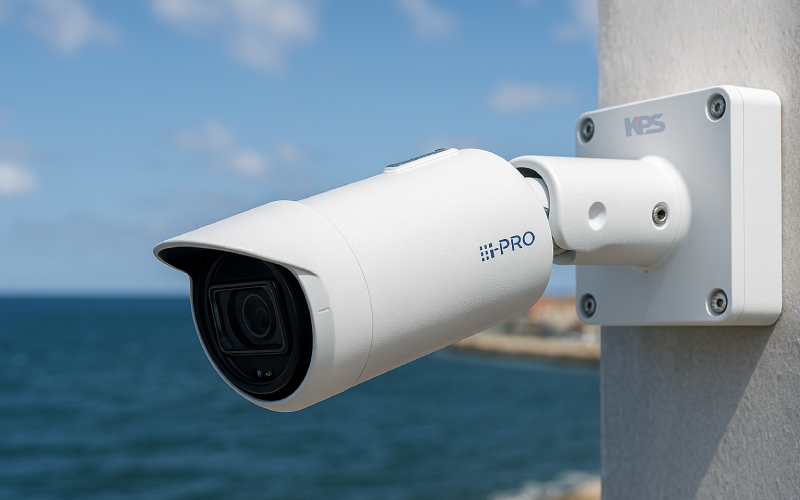
  • Corrosion protection extends equipment life: Housings made from materials like anodized aluminum alloy, 316L stainless steel, or salt-resistant coatings prevent corrosion effectively.
  • Compliance with harsh-environment standards: Many camera models meet standards like IP66/IP67 (dust/water resistance), IK10 (impact resistance), and Salt Fog Test certifications.
  • Stable, clear monitoring images: Prevents lens fogging and signal interference due to salt and moisture.
  • Lower operational and maintenance costs: Durable equipment reduces the need for replacements or repairs, enhancing return on investment.
  • Optimized performance in marine conditions: Specialized cameras maintain reliable operation even during storms, fog, or sea spray.

Camera with anti-corrosion cover and outstanding advantages

Cameras with corrosion-resistant housings are specifically designed to perform reliably in highly corrosive environments like coastal zones, seaports, coastal industrial areas, or chemical environments. These cameras use specialized housing materials and surface coatings to combat oxidation, corrosion from salt, moisture, chemicals, or other environmental factors.

Outstanding features of anti-corrosion cameras include

  • Housing made of epoxy-coated aluminum alloy, 316L stainless steel, or specialized composite materials.
  • Lens cover with nano-coating for water repellency and corrosion resistance.
  • Waterproof seals and rubber gaskets to block water and salt penetration.
  • Compliance with IP66/67/68, Salt Spray Test, or industrial corrosion standards like ASTM B117.

Working principle of camera with anti-corrosion housing

Fundamentally, corrosion-resistant cameras operate like standard surveillance cameras, consisting of:

  • Lens and image sensor: Capture visuals from the environment.
  • Image processor: Encodes and processes digital signals, producing clear images; may integrate AI for behavior, face detection, intrusion alerts.
  • Network module: Transmits footage via LAN or the internet to control centers or remote operators.
  • Storage: Saves images and video on memory cards, recorders, or cloud servers.

The main difference lies in:

  • Protective housing: The “lifesaver” shield that prevents damage to internal components from salt spray, moisture, seawater, or fine dust.
  • Anti-moisture and anti-corrosion technology: Prevents rust, electrical shorts, and image quality degradation.

Some high-end models also offer:

  • Integrated temperature and humidity sensors: Auto-adjust or alert in extreme conditions.
  • Built-in heaters: Prevent lens fogging early morning or at night.

Outstanding advantages of saltwater corrosion resistant cameras

Outstanding corrosion resistance in marine environments

Housing often made from rust-resistant aluminum alloy, 316L stainless steel, or coated with epoxy, anodized layers, or special salt‑resistant finishes.

Complies with Salt Fog Test standards (ASTM B117 or equivalent), ensuring resistance to salt corrosion.

Robust performance in harsh conditions

Rated IP66, IP67, or IP68—completely dust-tight and able to withstand long-term immersion.

Some models are IK10 rated for strong impact resistance, suitable for outdoor installation even in mechanically demanding areas.

Stable image quality

Lens cover treated with anti‑fog and water‑repellent coatings ensures consistently clear images despite salt mist or high humidity.

Equipped with modern sensors and AI technologies ensures behavior detection and motion recognition even in poor weather.

Cost savings & improved ROI

Durable, long-lasting devices significantly reduce maintenance and replacement costs.

Minimizes downtime or monitoring interruptions due to damage.

Easy integration into large surveillance systems

Supports ONVIF protocols for seamless integration with modern VMS (Video Management Systems).

Flexible connectivity with other security systems like alarms, access control, crowd analytics, or parking management.

Practical application of anti-corrosion camera

Corrosion-resistant cameras are not only ideal for marine settings but also serve as strategic surveillance solutions in environments demanding high durability and reliability. Common applications include:

  • Seaport and coastal logistics monitoring: Oversight of loading/unloading, container management, monitoring vehicles and personnel; helps reduce maintenance costs in high-salt conditions.
  • Coastal factories and industrial zones: Production safety, fire protection, asset monitoring, machinery surveillance in humid environments; often installed on poles, rooftops, or seaward perimeters; AI assists in access control and face recognition.
  • Seaside resorts, hotels, and villas: Asset protection, monitoring common areas like pools, lobbies, and entrances; cameras must maintain aesthetics and durability against sea winds, storms, and salty dust, combined with alarm systems and behavioral analytics.
  • Maritime vessels, piers, offshore oil platforms: Specialized cameras resistant to vibration and saltwater; suited to fishing boats, transport ships, military vessels; meet IP66/67, NEMA 4X, high-pressure and rough-sea standards; some include IR, optical zoom, and PTZ for long-range monitoring under all conditions.

Suggest some of the best saltwater corrosion resistant camera models available today

Camera IP Bullet WV‑S15500‑V3LK

The i‑PRO WV‑S15500‑V3LK is a premium outdoor AI bullet camera from the S‑Series, featuring a 1/2.8″ CMOS sensor and 5 MP resolution, delivering sharp footage even in low light with Color Night Vision technology. Ideal for advanced security applications with AI image analytics, FIPS 140‑2 Level 3 security, and NDAA compliance.

Key Features:

  • 5 MP CMOS sensor for clear imagery.
  • Integrated AI for person detection, vehicle analysis, face recognition, abnormal behavior, and sound detection (e.g. shouting, car honk, gunshot).
  • Color Night Vision in 0.05–0.07 lx.
  • Super Dynamic 132 dB for balanced highlights and shadows.
  • AI Smart Coding to reduce bandwidth/storage usage.
  • Built‑in IR LEDs with up to 55 m range.
  • Salt corrosion resistance per ISO 14993—marine‑grade durability.
  • Secure SE050F chip certified FIPS 140‑2 Level 3 (NXP EdgeLock).
  • NDAA compliant.
  • Max resolution 3072×2304 or 3072×1728; network via 10/100 Base‑TX; supports IPv4/IPv6, HTTPS, SSL, MQTT, SRTP.
  • Recording: removable microSD up to 512 GB; event, schedule, or network-loss triggered.
  • IP66-rated corrosion‑resistant housing; flexible mounting with PAN ±180°, TILT 0–100°, YAW ±190°.

Camera PTZ AI WV‑S6532LNS

The WV‑S6532LNS is a high‑end AI PTZ camera from i‑PRO, specially designed for coastal, industrial, or high-corrosion environments with ISO 14993 salt resistance. It offers exceptional monitoring: 22× optical zoom, Full HD 1080p at 60 fps, and 100 m IR night vision—in a rugged IP66, IK10, NEMA 4X body with built‑in fan, heater, and ClearSight coating.

Highlights:

  • Full HD 1920×1080 @ 60 fps, smooth and sharp under any lighting.
  • Color Night Vision in extremely low light (0.001 lx).
  • 22× optical and 16× digital zoom for detailed distant surveillance.
  • Extreme marine corrosion resistance (ISO 14993).
  • IP66, IK10, NEMA 4X; equipped with fan, heater, ClearSight.
  • AI (Intelligent Auto) and i‑VMD for smart motion recognition and image stabilization.
  • Continuous 360° pan, –30° to +210° tilt; presets up to 300°/s.
  • NDAA compliant—suitable for government/critical infrastructure.
  • Recording: built‑in SDXC slot up to 256 GB.
  • Power: AC24 V (55 W), PoE+ (25 W), or PoE injector 60 W.
  • Operating temperature: –40 °C to +60 °C; wind resistance up to 40 m/s; dimensions Ø249 mm × 465 mm.

Some other cameras and accessories

Not all outdoor surveillance cameras require an additional housing for marine-grade protection. Integrated designs certified NEMA 4X or IP66/IP67 are stable for installation on piers, outdoor poles, coastal factories, or resorts—without external housing.

Standards include: NEMA 4X (corrosion/salt‑fog), IP66/67 (dust/water), IK10 (impact), integrated corrosion‑resistant coatings.

Typical applications:

  • Outdoor monitoring on piers, container yards, coastal parking lots.
  • Installation on high‑mast poles, radar systems, or ships.
  • Coastal industrial zones, offshore wind power plants.
  • Seaside resorts and hotels requiring both aesthetics and durability.

Other notable cameras/accessories:

  • High‑end AI bullet cameras: WV‑S15500‑V3L, ‑V3LK, ‑V3LN, ‑V15700‑V2L, ‑V25500‑V3L
  • Outdoor PTZ cameras: WV‑S66600‑Z3LN, ‑S65501‑Z1G, ‑U65301‑Z1
  • Mini dome cameras for near‑sea use (IP66/NEMA 4X): WV‑U2130LA, ‑U2142LA, ‑S2536LA, ‑S2136LA
  • Corrosion‑resistant models with integrated housings: WV‑S85402‑V2L, ‑U85402‑V2L
  • Accessories: mounting brackets, junction boxes, control units, software—e.g. WV‑QWL501‑W, WV‑PM500, WV‑CU980, WV‑ASM300W, WJ‑NX310KG, MV‑QEM505‑W.

Câu hỏi thờng gặp

Camera chống ăn mòn muối biển có cần bảo trì thường xuyên không?
Có, dù được thiết kế để chịu đựng môi trường khắc nghiệt, nhưng việc kiểm tra định kỳ vẫn giúp kéo dài tuổi thọ và hiệu suất camera.
Tại sao camera thường bị hư hỏng nhanh khi lắp ở khu vực ven biển?
Do hơi muối, độ ẩm cao và khí hậu khắc nghiệt dễ gây ăn mòn linh kiện, gỉ sét và hỏng hóc các bộ phận quan trọng.
Camera chống ăn mòn có khác gì so với camera ngoài trời thông thường?
Có lớp vỏ đặc biệt, đạt chuẩn như NEMA 4X, IP66 hoặc IP67, chịu được hơi muối, gió biển, mưa lớn và tác động vật lý.
Có cần dùng thêm housing bảo vệ cho camera chống ăn mòn không?
Nếu khu vực quá khắc nghiệt, bạn có thể dùng housing chuyên dụng để tăng cường khả năng bảo vệ.
Nên chọn hãng nào uy tín cho camera chống ăn mòn?
Các thương hiệu như i-PRO (Panasonic) nổi bật với các dòng đạt chuẩn NEMA 4X, IP67, thiết kế cho môi trường biển.

Other news

What is Lane Departure Warning System (LDWS)? How it works & practical benefits

What is Lane Departure Warning System (LDWS)? How it works & practical benefits

LDWS is a lane departure warning system that uses a front-facing camera to detect lane markings. When the vehicle unintentionally drifts out of its lane without the turn signal..

View detail

AI Camera & Zero Trust Security Vietnam 2025 Conference

AI Camera & Zero Trust Security Vietnam 2025 Conference

The AI ​​Camera & Zero Trust Security 2025 conference provides a space for in-depth exchange and connection of smart security solutions for the future.”

View detail

MES System | The Role of MES in Smart Manufacturing

MES System | The Role of MES in Smart Manufacturing

MES manages real-time production, optimizes quality, productivity, connects ERP, SCADA & IoT for factory 4.0.

View detail

Blockchain Technology: A Revolutionary Solution for the Digital Future in the AI ​​Era

Blockchain Technology: A Revolutionary Solution for the Digital Future in the AI ​​Era

Blockchain is a distributed ledger. Instead of storing data on a central server (like a bank or Facebook), blockchain stores data on thousands of computers in a network.

View detail

Security Monitoring Solutions for Data Center

Security Monitoring Solutions for Data Center

A Data Center (DC) is the central location that houses all servers, storage systems, and mission-critical infrastructure of an organization. Even a minor incident — power loss,..

View detail

KPS accompanies Gia Dinh University at the Workshop: AI Everywhere

KPS accompanies Gia Dinh University at the Workshop: AI Everywhere

KPS and Gia Dinh University organized the Workshop "AI Everywhere", sharing AI applications from experts from CNB, Seagate, Mitel, inspiring technology for Gen Z.

View detail

LEGO Binh Duong Factory | Zero-Emission Factory in Vietnam

LEGO Binh Duong Factory | Zero-Emission Factory in Vietnam

LEGO Binh Duong Factory - a 1.3 billion USD FDI project that meets Carbon Neutral standards, a symbol of green and high-tech production in Vietnam.

View detail

1 2 3 4 5
Công ty cổ phần Hệ Thống An Ninh Khai Phát (gọi tắt là Công ty KPS). GPDKKD: 0310471658 do sở KH & ĐT TP.HCM cấp ngày 24/11/2010. Đại diện pháp luật: Đinh Tấn Đạt.

2010 © Bản quyền thuộc KPS

Online: 19 | Visitors Counter: 13466335

About | Recruitment | News | Contact Us

zalo
messenger