KPS System Corp | Công ty cổ phần Hệ Thống An Ninh Khai Phát

Maintain FM200 system according to NFPA 2001 standards

A properly installed FM200 fire suppression system without regular maintenance is like a rotten umbrella - it looks safe but when needed, it cannot save you. Did you know that just a small error such as a gas leak, a faulty sensor or a stuck valve can disable the entire system, putting your business at risk of billions of dong in property damage and seriously violating fire safety regulations?

So how can you be sure that the FM200 system is always ready to protect you at the right time? Let's find out with KPS the importance of FM200 system maintenance and the optimal solution to give you absolute peace of mind!

Introducing the FM200 system

What is FM200? (Fire extinguishing clean gas - Halocarbon - HFC-227ea)

FM200 (HFC-227ea) is a clean fire extinguishing gas belonging to the Halocarbon group, commonly used in automatic fire extinguishing systems. FM200 was developed to replace Halon – a fire extinguishing agent that has been phased out due to its impact on the ozone layer.

Features of FM200:

  • Chemical name: Heptafluoropropane – HFC-227ea
  • Extinguishes fires extremely quickly (usually less than 10 seconds)
  • Colorless, odorless
  • Non-conductive, safe for electronic equipment
  • Leaves no residue after discharge, does not cause property damage
  • Affects the chemical reaction chain of the fire, extinguishes quickly in just a few seconds.

Applications of FM200 Fire Suppression System

FM200 fire suppression system is suitable for areas with electronic equipment, important data or high-value assets, such as:

  • Server room, data center
  • Server room, control room
  • Document storage room, material warehouse
  • Medical equipment room, electronics, telecommunications
  • Electrical cabinet, generator room

Why is FM200 system maintenance important?

FM200 gas fire suppression system plays an extremely important role in protecting people, assets and data in important areas such as server rooms, data centers, power stations, storage warehouses, etc. However, if not periodically maintained, the FM200 system may operate ineffectively or not activate when a fire or explosion occurs. Here are the top reasons for regular maintenance:

Ensure the system is always ready to operate

  • Check and detect technical errors early such as: gas leaks, stuck valves, incorrect sensors, etc.
  • Ensure the system is activated at the right time and in the right way in an emergency

Comply with fire safety standards

  • According to international standards NFPA 2001 and Vietnamese standards TCVN 3890, FM200 fire extinguishing systems must be inspected and maintained periodically every quarter and every year
  • This is a mandatory condition for the unit to be licensed to operate and accept fire protection

Prolong the life of the equipment

  • Equipment such as gas cylinders, sensors, control cabinets, etc., if not inspected, will quickly deteriorate
  • Periodic maintenance helps maintain the accuracy and long-term stability of the entire system

Avoid the risk of FM200 gas leakage

  • FM200 gas is expensive, if it leaks, it will cause serious economic damage
  • Leaks are not timely detection can affect the health of the operator and the environment

Ensure effective fire extinguishing

  • The system can extinguish fires quickly within seconds if the sensors and nozzles are working correctly
  • Any error can cause the entire system to be disabled when necessary

Minimize legal and insurance risks

  • If the FM200 system is not properly maintained, when a fire occurs, it may not be covered by insurance
  • Legal burden due to violation of fire prevention regulations

Recommended maintenance time and frequency of FM200

Recommended maintenance time and frequency of FM200 system must comply with international standards (NFPA 2001) and regulations in Vietnam (TCVN 3890, TCVN 5760, ...).

Monthly inspection

  • Check the pressure of the FM200 gas tank
  • Ensure the discharge valve is sealed, not damaged or missing the label
  • Check the error light signal, alarm
  • Ensure the power source and backup battery are stable
  • Record the pressure index and make a record

Quarterly maintenance (3 months/time)

  • Check all heat - smoke - gas sensors
  • Clean the nozzle, gas pipe
  • Test the discharge simulation function, check the relay
  • Check the central control cabinet and the connecting modules

Annual maintenance (12 months/time)

  • Calibrate the sensor according to the manufacturer's standards
  • Check the FM200 gas volume in the tank by weighing or ultrasound
  • Check the tightness of the system - prevent leakage
  • Test the simulated system (no gas discharge)

Overall assessment and make a maintenance report - system inspection

Important note:

When the system shows signs of abnormality: gas leakage, warning light error, pressure drop... need to be checked urgently, do not wait until the regular schedule.

After discharging gas (whether test or real), it is mandatory to check, refill gas, and recalibrate the entire system.

Standard technical maintenance process of FM200 system

FM200 system maintenance must be performed according to the correct technical process to ensure absolute safety, avoid gas leakage and maintain effective fire extinguishing ability. Below are the standard maintenance steps applied to FM200 clean gas fire extinguishing system:
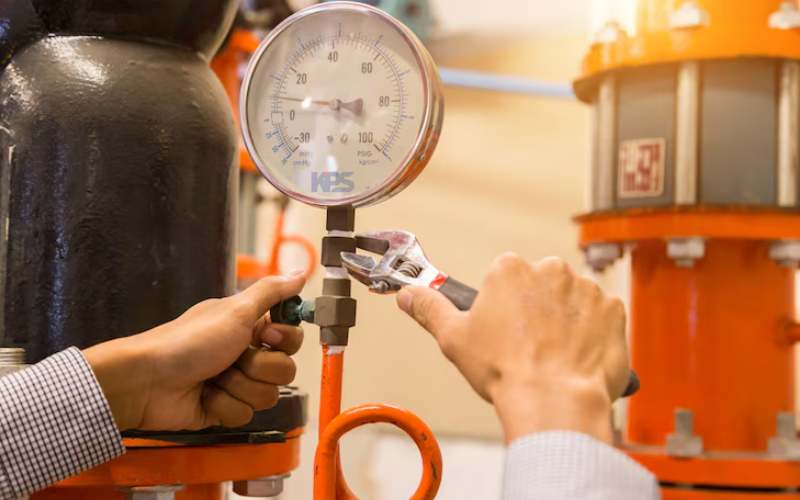
Survey the current status of the system

  • Determine the location of gas cylinders, nozzles, sensors, control cabinets
  • Preliminary check of the operating status of the system
  • Assess the risk of leakage, damage or failurei signal deviation
  • Record all parameters, test results.
  • Recommend solutions (if there is a problem).
  • Make a maintenance handover record with both parties' signatures.

Check FM200 gas tank

  • Measure tank pressure with a specialized gauge
  • Weigh gas mass or use ultrasound to check remaining capacity
  • Check tightness, seal, location and inspection stamp

Check central control cabinet

  • Ensure cabinet has main and backup power source
  • Check indicator light system, alarm siren, emergency button
  • Test control relays, activation output, connection module

Check sensors and probes

  • Clean dust from smoke, heat, gas sensors
  • Check input signal at control cabinet
  • Try to simulate fire situation to verify sensor operation

Check sprinkler system and pipeline

  • Check gas pipeline for cracks, leaks
  • Clean sprinkler, ensure no blockage
  • Check bracket, installation location according to design

Check discharge valve - solenoid valve

  • Check mechanical operation of valve
  • Ensure valve opens properly when receiving electromagnetic signal
  • Clean and lubricate (if necessary)

Test the system (simulate no gas discharge)

  • Activate the fire simulation from the sensor
  • Observe the operation of bells, sirens, warning lights, relays
  • Ensure the system responds correctly according to the fire fighting procedure

Record, evaluate and make a maintenance record

  • Record all parameters, test results
  • Recommend solutions (if there is a problem)

Record, evaluate and make a maintenance record

How much does it cost to maintain an FM200 system?

The cost of maintaining an FM200 fire suppression system can vary depending on the scale, number of gas cylinders, the level of detailed inspection and the service provider. Below are the factors that affect the cost of FM20 maintenance.

System size and configuration

  • The more FM200 gas cylinders, the longer the inspection time, leading to increased costs.
  • The length of the gas pipe, the number of nozzles, the installation location (on the ceiling, in the electrical cabinet, in the basement, etc.) affect the level of complexity when maintaining.
  • Systems with many independent zones and many sensors will require technicians with higher expertise.

System status at the time of inspection

  • New, stable systems often have lower costs.
  • Old systems that are not regularly maintained often need to replace components and recalibrate sensors, leading to significant cost increases.
  • If an FM200 gas leak or a damaged solenoid valve is detected, the repair cost will be calculated separately.

Level of detail of maintenance service

  • Basic inspection package: Only general inspection, no system test
  • Intensive package: Including sensor calibration, gas mass check, non-discharge simulation test, resistance test... will have a higher price
  • Requirements for inspection records, fire protection legal documents also increase costs

Special requests from customers

  • Maintenance outside of business hours, at night, or on weekends
  • Maintenance areas located in clean rooms, data centers, cold storage, pharmaceutical factories require special construction conditions
  • Customers request maintenance without system interruption, still maintaining operations requires more experienced technicians

Location and geographical location

  • Inner city areas (HCMC, Hanoi) are usually cheaper
  • If the system is located in industrial parks, remote areas, additional travel and accommodation costs for technicians must be calculated

Maintenance frequency according to contract

  • Annual maintenance (full package) is usually cheaper than maintenance single time
  • Signing a long-term contract (1-3 years) often has a cost discount of 10% - 30%

Notes when choosing an FM200 maintenance unit

Choosing a reputable, professional maintenance unit is a key factor to ensure that the FM200 fire suppression system operates effectively, safely and in compliance with legal regulations. Here are some important notes:

The unit has a legal license and fire protection certificate

  • Must be a unit licensed to operate in the field of fire protection by the competent authority.
  • Have a team of technicians with fire protection certificates, trained in FM200 clean gas fire suppression systems.
  • Have constructed or maintained FM200 projects for office buildings, data centers, archives, factories, etc.
  • Can provide a list of completed projects, acceptance records, and periodic inspection records.
  • Full range of pressure measuring devices, mass scales, ultrasonic gas testers, sensor signal testing equipment, etc.
  • Use correct technical methods, do not conduct manual or cursory inspections

Practical experience in the FM200 field

  • Have constructed or maintained FM200 projects for office buildings, data centers, archives, factories, etc.
  • Can provide a list of completed projects, acceptance records, and periodic inspection records
  • Full and modern inspection equipment
  • Full range of pressure measuring devices, mass scales, ultrasonic gas testers, sensor signal testing equipment, etc.
  • Use correct technical methods, do not conduct manual or cursory inspections

Provide full maintenance records and minutes

  • After maintenance, must provide acceptance records, measurement results, and system status assessment reports
  • If necessary, must support fire prevention and fighting inspection records, records for inspection or insurance
  • Have a contract contracts, commitments and warranties are clear
  • The contract should clearly state the scope of work, implementation time, warranty terms
  • There is a post-maintenance technical warranty policy, quick troubleshooting within 24-48 hours if problems arise

Honest advice - no unreasonable costs

  • Clear advice on system status, no "painting" or vague quotes
  • There is a transparent price list, specific quotes for each inspection item
  • Received good reviews from previous customers
  • There is positive feedback from units that have used the service
  • Priority should be given to units with actual reviews on Google Maps, social networks, websites, etc.

Why should you choose KPS as a unit to maintain the FM200 system

With more than 15 years of in-depth experience in the field of fire prevention and fighting (PCCC), KPS is not only an official distributor of the world's leading brands such as BOSCH, GST, Janus Fire System, Simplex, ..., but also a prestigious consulting unit in design, construction and maintenance of PCCC systems, trusted by hundreds of large enterprises small businesses nationwide trust and choose.

KPS is proud to provide comprehensive FM200 system maintenance solutions, strictly complying with NFPA 2001 and TCVN 3890 standards, ensuring that the system is always ready to operate correctly when there is an incident. Our team of technicians all have Fire Prevention and Fighting certificates, are well-trained in clean gas systems (HFC-227ea), are proficient in checking, detecting gas leaks, weighing and checking cylinder weight, calibrating sensors, and handling technical errors such as stuck valves, incorrect sensors, etc.

Not only stopping at maintenance, KPS also provides technical advice, provides legal documents, full acceptance records - supporting businesses in the inspection, acceptance and fire insurance requirements. In particular, KPS's pricing policy is transparent - no additional costs - with warranty, with flexible periodic maintenance packages (quarterly or yearly), helping to optimize costs and extend equipment life.

With a solid technical foundation, modern testing equipment and extensive experience in practical implementation at key projects, KPS is the top choice in FM200 system maintenance services - where you can be completely assured of the quality, progress and safety of your fire protection system.

Contact KPS now for optimal technical solution advice, transparent quotes and quick maintenance support!


Câu hỏi thờng gặp

Bao lâu cần kiểm tra áp suất bình khí FM200?
Ít nhất mỗi 6 tháng/lần, theo NFPA 2001 – để đảm bảo không bị thất thoát khí, nếu phát hiện sụt áp quá mức cho phép (5–10%), cần nạp lại hoặc thay thế bình.
Có cần hiệu chuẩn hệ thống cảnh báo sớm trong hệ FM-200 không?
Có. Hệ thống đầu báo khói, cảnh báo sớm và trung tâm điều khiển cần được hiệu chuẩn định kỳ, tránh báo sai hoặc chậm trễ khi xảy ra sự cố.
Có cần kiểm tra lại hệ thống sau khi đã xả khí không?
Có. Sau khi xả khí (dù là thực tế hay kiểm tra mô phỏng), cần kiểm tra lại toàn bộ cảm biến, bình khí, đường ống, đầu phun, và nạp khí lại nếu cần.

Other news

What is Lane Departure Warning System (LDWS)? How it works & practical benefits

What is Lane Departure Warning System (LDWS)? How it works & practical benefits

LDWS is a lane departure warning system that uses a front-facing camera to detect lane markings. When the vehicle unintentionally drifts out of its lane without the turn signal..

View detail

AI Camera & Zero Trust Security Vietnam 2025 Conference

AI Camera & Zero Trust Security Vietnam 2025 Conference

The AI ​​Camera & Zero Trust Security 2025 conference provides a space for in-depth exchange and connection of smart security solutions for the future.”

View detail

MES System | The Role of MES in Smart Manufacturing

MES System | The Role of MES in Smart Manufacturing

MES manages real-time production, optimizes quality, productivity, connects ERP, SCADA & IoT for factory 4.0.

View detail

Blockchain Technology: A Revolutionary Solution for the Digital Future in the AI ​​Era

Blockchain Technology: A Revolutionary Solution for the Digital Future in the AI ​​Era

Blockchain is a distributed ledger. Instead of storing data on a central server (like a bank or Facebook), blockchain stores data on thousands of computers in a network.

View detail

Security Monitoring Solutions for Data Center

Security Monitoring Solutions for Data Center

A Data Center (DC) is the central location that houses all servers, storage systems, and mission-critical infrastructure of an organization. Even a minor incident — power loss,..

View detail

KPS accompanies Gia Dinh University at the Workshop: AI Everywhere

KPS accompanies Gia Dinh University at the Workshop: AI Everywhere

KPS and Gia Dinh University organized the Workshop "AI Everywhere", sharing AI applications from experts from CNB, Seagate, Mitel, inspiring technology for Gen Z.

View detail

LEGO Binh Duong Factory | Zero-Emission Factory in Vietnam

LEGO Binh Duong Factory | Zero-Emission Factory in Vietnam

LEGO Binh Duong Factory - a 1.3 billion USD FDI project that meets Carbon Neutral standards, a symbol of green and high-tech production in Vietnam.

View detail

1 2 3 4 5
Công ty cổ phần Hệ Thống An Ninh Khai Phát (gọi tắt là Công ty KPS). GPDKKD: 0310471658 do sở KH & ĐT TP.HCM cấp ngày 24/11/2010. Đại diện pháp luật: Đinh Tấn Đạt.

2010 © Bản quyền thuộc KPS

Online: 13 | Visitors Counter: 13532238

About | Recruitment | News | Contact Us

zalo
messenger