


info@kps.com.vn
+84 903 709 019
EN 54 Standard – The “Gold Benchmark” in Fire Alarm Systems In the field of fire protection, the EN 54 standard is considered the “gold benchmark” for quality and reliability of modern fire alarm systems.
Issued by CEN (European Committee for Standardization), EN 54 sets strict requirements for the design, performance, and testing of every component — from fire alarm control panels and smoke detectors to sounders, beacons, and power supplies.
Choosing EN 54-certified products not only ensures safety for the building but also meets technical requirements for international projects, enhancing reputation and brand value.
EN 54 is a series of European Standards (EN) for Fire Detection and Fire Alarm Systems.
It was developed by the Comité Européen de Normalisation (CEN) through its Technical Committee TC 72 – Fire detection and fire alarm systems.
Purpose:
To define performance, testing, and interoperability requirements for fire detection and alarm system components — ensuring safety of life and property.
EN 54 is developed by the European Committee for Standardization (CEN) under Technical Committee CEN/TC 72 “Fire detection and fire alarm systems.”
It is not a single standard but a series of standards (Parts) — each specifying requirements for a particular device or system function within a fire alarm system.
Objective:
To ensure that every component in a fire detection and alarm system meets minimum performance, testing, and evaluation requirements — guaranteeing reliable operation in case of fire.
When a product complies with EN 54 and is certified accordingly, it serves as a technical passport allowing it to be accepted in the European market and recognized globally by customers, contractors, and investors.
EN 54 is mandatory (in many cases) for products used in fire detection and alarm systems across the European Union.
Under the Construction Products Regulation (CPR 305/2011), when a product bears the CE marking and falls within a harmonized standard, EN 54 is one of the key references applied.
It supports harmonization of quality standards among EU countries, enabling approved devices to circulate freely and be used across borders without re-testing.
For building managers, contractors, and investors, using EN 54-certified devices means choosing components that meet recognized performance and testing standards — increasing reliability and minimizing operational risks.
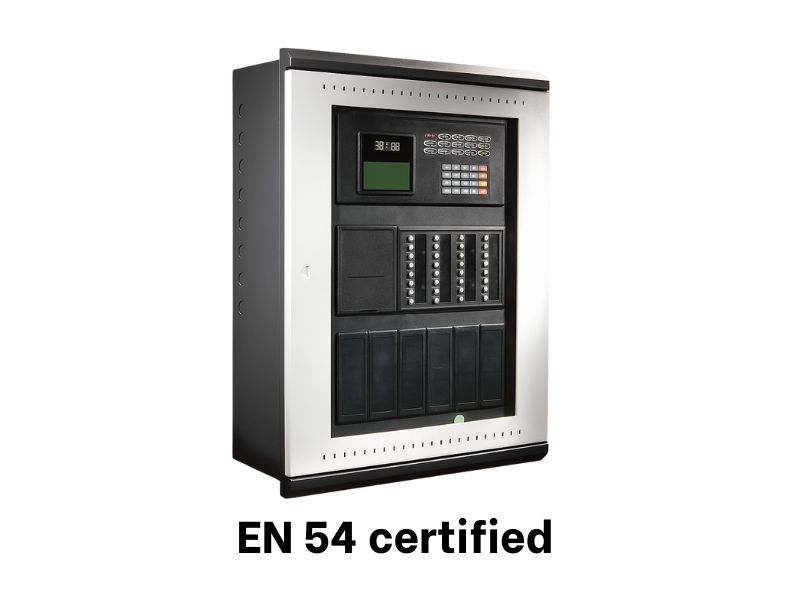
Here are some key examples illustrating how EN 54 is divided according to device types:
EN 54-2: Control and indicating equipment (Fire alarm control panel)
EN 54-4: Power supply equipment
EN 54-5: Heat detectors – Point heat detectors
EN 54-7: Smoke detectors – Point type using scattered light, transmitted light or ionization
EN 54-20: Aspirating smoke detectors
EN 54-23: Fire alarm devices – Visual alarm devices (beacons)
EN 54-13: Compatibility and connectivity assessment of system components — ensures that individual devices can operate together as part of a complete system.
When designing a fire alarm system for buildings, factories, or hotels, all components — including smoke detectors, heat detectors, manual call points, sounders, beacons, and control panels — should comply with the relevant EN 54 part.
Using EN 54-compliant equipment simplifies fire safety approval processes and helps obtain acceptance from local authorities.
In marketing and sales, emphasizing that a product is “EN 54 certified” enhances its technical credibility, builds customer trust, and increases conversion rates.
In regions outside the EU (such as Vietnam), EN 54 compliance is not always mandatory. However, many international projects and investors still prefer EN 54-certified systems to meet European standards and enhance project value.
Not all EN 54 parts are mandatory in every situation — it depends on the country, building type, and local regulations.
Certain systems (e.g., wireless or temporary setups) may fall outside EN 54 scope and require separate evaluation.
Other news

Signify and KPS sign strategic partnership agreement.
Signify and KPS have signed a strategic partnership to promote smart, energy-efficient lighting solutions for buildings in Vietnam.
View detail

From APEC 2017 Da Nang to APEC 2027 Phu Quoc: From traditional security solutions to smart IOCs.
From APEC 2017 security monitoring solutions to a smart IOC model for APEC 2027 in Phu Quoc.
View detail

Team Building KPS 2026 | Da Nang - Hoi An - Hue
KPS 2026 Team Building journey in Da Nang - Hoi An - Hue, where teams bond, recharge, and spread sustainable values.
View detail

Optimizing air conditioning based on room conditions in hotels and resorts.
Why do 20-30% of hotel rooms still have their air conditioning running even when there are no guests?
View detail

Energy-saving solutions for hotels and resorts - without compromising the experience.
Consulting and implementing EMS systems for hotels - reducing electricity costs, smarter operation - without compromising customer experience.
View detail

Energy Management System (EMS): Cost and Operation Optimization
EMS solutions help businesses monitor, analyze, and optimize energy in real time, saving 10-30% on electricity costs.
View detail
ABOUT KPS


Regulations and policies
Warranty and return policy Delivery, payment, and feedback Giấy phép kinh doanhContact Information
HO CHI MINH OFFICE
10–12 Dong Van Cong Street, Cat Lai Ward, Ho Chi Minh City.
+842839976099 / 903 709 019
info@kps.com.vn
www.kps.com.vn
Work time
Monday – Friday : 8:00 AM - 17:30 PM
Saturday - Sunday: Off
HA NOI OFFICE
22 Alley 168 Nguyen Xien, Khuong Dinh Ward, Hanoi City
+84 903 709 019
kpshn@kps.com.vn
www.kps.com.vn
Work time
Monday – Friday: 8:00 AM - 17:30 PM
Saturday - Sunday: Off
DA NANG OFFICE
490 Nguyen Tri Phuong, Hoa Cuong Ward, Da Nang City
+84 903 709 019
kpsdn@kps.com.vn
www.kps.com.vn
Work time
Monday – Friday: 8:00 AM - 17:30 PM
Saturday - Sunday: Off
CAN THO OFFICE
11/11 Tran Binh Trong, Ninh Kieu Ward, Ninh Kieu District, Can Tho City.
+84 090 709 019
kpsct@kps.com.vn
www.kps.com.vn
Work time
Monday – Friday: 8:00 AM - 17:30 PM
Saturday - Sunday: Off
SERVICE CENTER - WAREHOUSE
10–12 Dong Van Cong Street, Cat Lai Ward, Ho Chi Minh City.
+ 84 28 3997 0609
baohanh@kps.com.vn
www.kps.com.vn
Work time
Monday – Friday: 8:00 AM - 17:30 PM
Saturday - Sunday: Off
2010 © Bản quyền thuộc KPS
Online: 17 | Visitors Counter: 17009265
About | Recruitment | News | Contact Us


.png)


