


info@kps.com.vn
+84 903 709 019
When choosing outdoor equipment such as surveillance cameras, electrical enclosures, or industrial devices, understanding protection standards like IP66 and NEMA 4X is key to ensuring long-term durability and performance. This article will compare IP66 and NEMA 4X in detail and offer practical tips to help you select the right certified equipment for your specific needs.
IP stands for Ingress Protection, defined by the International Electrotechnical Commission (IEC). It measures how well an enclosure resists ingress from solid objects (like dust) and liquids (like water).
The IP rating consists of two digits, each with specific meaning:
First digit (6): Protection against solid objects (dust)
A “6” indicates full dust ingress protection—no dust can enter the enclosure.
Second digit (6): Protection against liquids (water)
A “6” indicates protection from powerful water jets: the device can withstand water sprayed from a 12.5 mm nozzle from any direction without harm.
| Environment | Protection Level |
|---|---|
| Fine dust and sand | 100% sealed |
| Heavy rainfall, strong jetting from hoses | Fully protected |
| Outdoor use | Very suitable |
Outdoor surveillance cameras
Industrial LED lighting
Electrical cabinets and junction boxes
Sensors and instruments in dusty or wet conditions
IP66 does not cover long-term immersion (e.g., underwater use in tanks).
Does not include protection against chemical or salt corrosion—consider additional standards like NEMA if needed.
NEMA stands for the National Electrical Manufacturers Association in the U.S., which issues standards for electrical enclosure performance. NEMA 4X represents one of the higher protection levels.
Dust and weather protection: Sealed from dust, wind-blown particulates, rain, and snow—suitable for both indoor and outdoor use.
Hose-directed water resistance: Similar to NEMA 4, able to withstand water sprayed from hoses.
Ice formation protection: Enclosures resist damage caused by ice buildup, critical in cold climates.
Corrosion resistance: The “X” rating denotes enhanced resistance against corrosion from salt, chemicals, or cleaning agents.
| Factor | Protection Level |
|---|---|
| Dust/debris | Yes |
| Rain/pressure spray | Yes |
| Corrosion (salt mist, light chemicals) | Yes |
| Outdoor use | Very suitable |
| Weather-induced cracking | Resistant |
Outdoor or coastal electrical cabinets
Control equipment in chemical plants
Industrial-grade security cameras
Electrical panels in humid, saline, or chemical environments
| Criteria | IP66 (IEC Standard) | NEMA 4X (NEMA Standard) |
|---|---|---|
| Issuing organization | IEC (international) | NEMA (U.S./Canada) |
| Global usage | Worldwide, especially Europe & Asia | Primarily North America |
| Rating structure | Two digits: solid (0–6), liquid (0–9) | Single code with environmental definitions and an optional “X” modifier |
| Testing Focus | Dust and liquid ingress | Dust, water, ice, corrosion, and sometimes oils or explosion-proof |
| Equivalent protection | Solid & water similar to NEMA 4/4X | Matches IP66 for dust/water, plus corrosion and freezing resistance |
| For harsh conditions | Effective for dust and water | Superior in corrosive or chemically aggressive environments |
Selecting between IP66 and NEMA 4X isn’t just about higher nominal protection—it’s about matching the standard to your specific environmental conditions to optimize cost, durability, and performance.
Dust environment?
Both IP66 and NEMA 4X offer full dust protection (IP6).
Water exposure?
For heavy rain or water from hoses, choose at least IP66 or NEMA 4X.
If immersion is possible, consider IP67/IP68 or NEMA 6/6P instead.
Corrosive conditions?
Coastal salt air, chemical plants, or strong cleaning agents demand NEMA 4X.
IP66 alone won’t prevent corrosion over time.
Freezing conditions?
NEMA 4X also protects against enclosure damage from ice buildup; IP66 doesn’t explicitly mention this.
In North America, NEMA standards are prevalent and may be required.
Elsewhere, IP ratings are more widely adopted.
Industry-specific regulations could mandate certain ratings.
NEMA 4X enclosures typically cost more due to corrosion-resistant materials.
But they offer lower maintenance and longer lifespan in harsh environments.
Compare upfront cost with long-term reliability.
Residential or office outdoor cameras: IP66 is typically enough.
Cameras at the seaside or ports: NEMA 4X is ideal due to salt corrosion.
Food processing or chemical plant cameras: NEMA 4X often required for chemical resistance.
Industrial dust/wet environments without chemical exposure: IP66 is a cost-effective choice.
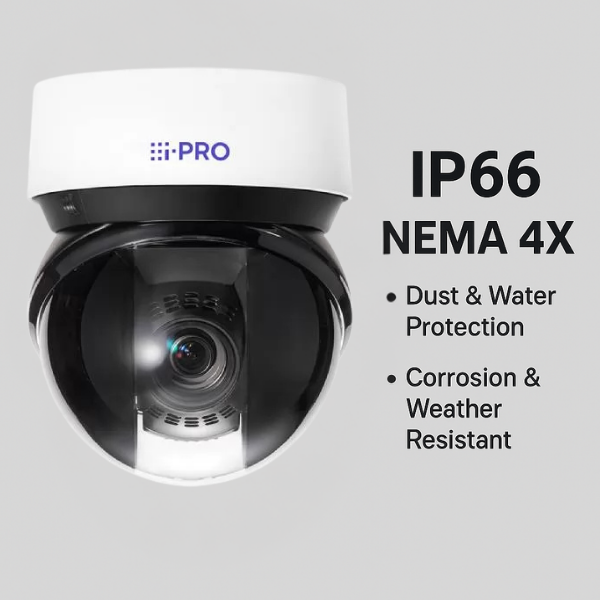
Combining both standards delivers robust protection across harsh conditions:
Dust resistance: Fully sealed against dust prevent damage to optics and electronics.
Water resistance: Withstands heavy rain and pressure washing.
Broader protection: Matches IP66 for dust/water and adds ice-resistance.
Corrosion defense: Rose to resist salt air, chemicals, cleaning agents—important in coastal, industrial, or heavily washed environments.
Extra durability: Withstands multiple environmental threats (dust, water, corrosion).
Reliable operation: Reduces risk of damage or downtime.
Lower maintenance costs: Less replacement and servicing needed.
Flexible deployment: Suitable for seaside, industrial, food/pharma, and extreme climates.
WV‑S2536LA
WV‑S15700‑V2L
WV‑S15500‑V3LK
WV‑S1536LA
Other news

Signify and KPS sign strategic partnership agreement.
Signify and KPS have signed a strategic partnership to promote smart, energy-efficient lighting solutions for buildings in Vietnam.
View detail

From APEC 2017 Da Nang to APEC 2027 Phu Quoc: From traditional security solutions to smart IOCs.
From APEC 2017 security monitoring solutions to a smart IOC model for APEC 2027 in Phu Quoc.
View detail

Team Building KPS 2026 | Da Nang - Hoi An - Hue
KPS 2026 Team Building journey in Da Nang - Hoi An - Hue, where teams bond, recharge, and spread sustainable values.
View detail

Optimizing air conditioning based on room conditions in hotels and resorts.
Why do 20-30% of hotel rooms still have their air conditioning running even when there are no guests?
View detail

Energy-saving solutions for hotels and resorts - without compromising the experience.
Consulting and implementing EMS systems for hotels - reducing electricity costs, smarter operation - without compromising customer experience.
View detail

Energy Management System (EMS): Cost and Operation Optimization
EMS solutions help businesses monitor, analyze, and optimize energy in real time, saving 10-30% on electricity costs.
View detail
ABOUT KPS


Regulations and policies
Warranty and return policy Delivery, payment, and feedback Giấy phép kinh doanhContact Information
HO CHI MINH OFFICE
10–12 Dong Van Cong Street, Cat Lai Ward, Ho Chi Minh City.
+842839976099 / 903 709 019
info@kps.com.vn
www.kps.com.vn
Work time
Monday – Friday : 8:00 AM - 17:30 PM
Saturday - Sunday: Off
HA NOI OFFICE
22 Alley 168 Nguyen Xien, Khuong Dinh Ward, Hanoi City
+84 903 709 019
kpshn@kps.com.vn
www.kps.com.vn
Work time
Monday – Friday: 8:00 AM - 17:30 PM
Saturday - Sunday: Off
DA NANG OFFICE
490 Nguyen Tri Phuong, Hoa Cuong Ward, Da Nang City
+84 903 709 019
kpsdn@kps.com.vn
www.kps.com.vn
Work time
Monday – Friday: 8:00 AM - 17:30 PM
Saturday - Sunday: Off
CAN THO OFFICE
11/11 Tran Binh Trong, Ninh Kieu Ward, Ninh Kieu District, Can Tho City.
+84 090 709 019
kpsct@kps.com.vn
www.kps.com.vn
Work time
Monday – Friday: 8:00 AM - 17:30 PM
Saturday - Sunday: Off
SERVICE CENTER - WAREHOUSE
10–12 Dong Van Cong Street, Cat Lai Ward, Ho Chi Minh City.
+ 84 28 3997 0609
baohanh@kps.com.vn
www.kps.com.vn
Work time
Monday – Friday: 8:00 AM - 17:30 PM
Saturday - Sunday: Off
2010 © Bản quyền thuộc KPS
Online: 20 | Visitors Counter: 17758127
About | Recruitment | News | Contact Us


