


info@kps.com.vn
+84 903 709 019
Are you sure you understand traffic cameras, AI cameras, and how this monitoring system works?
Many people are surprised to receive traffic violation notices even though they weren't stopped by traffic police at the time of the violation. This raises a series of questions: Which camera recorded the incident? Are all cameras on the road used for issuing fines? Do AI cameras "see" every violation?
In reality, traffic cameras aren't just individual cameras, but part of an intelligent traffic monitoring system. This article will decode how this system actually works, why some people are fined despite having cameras, and when camera data is legally sufficient to issue a fine.
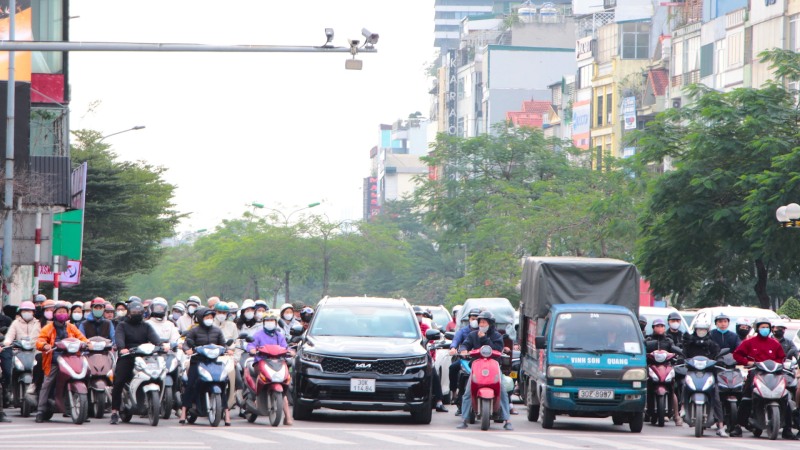
AI cameras contribute to building a traffic culture and a civilized urban lifestyle - Photo: Government Policy Development
Not all cameras are traffic cameras for issuing fines.
A common misconception today is that all traffic cameras are used for issuing fines. In reality, many cameras only serve to observe traffic conditions, regulate traffic lights, analyze vehicle density, and assist in handling incidents. Without this understanding, people can easily become confused while traveling, misunderstand the role of cameras, and equate all surveillance systems with enforcement.
Traffic cameras for issuing fines are simply monitoring points that must simultaneously meet the following conditions:
The cold fine camera system is often deployed at key traffic locations such as: intersections, highways, overpasses, toll stations... to record images and videos of moving vehicles.
The operating mechanism includes 4 main stages:
The camera automatically records continuously and detects violations such as: running red lights, speeding, driving in the wrong lane, stopping and parking in violation of regulations,...
Using AI and ANPR (Automatic Number Plate Recognition) technology to accurately identify vehicle license plates in all weather and light conditions.
Image data, videos and violation information are encoded and sent to the Traffic Control Center (IOC) via a high-speed network connection.
The software automatically analyzes data, compares vehicle registration information, then transfers electronic records to the police or the violation handling agency.
In the Smart Traffic or Smart City model, the cold fine camera is an important link in the overall monitoring network:
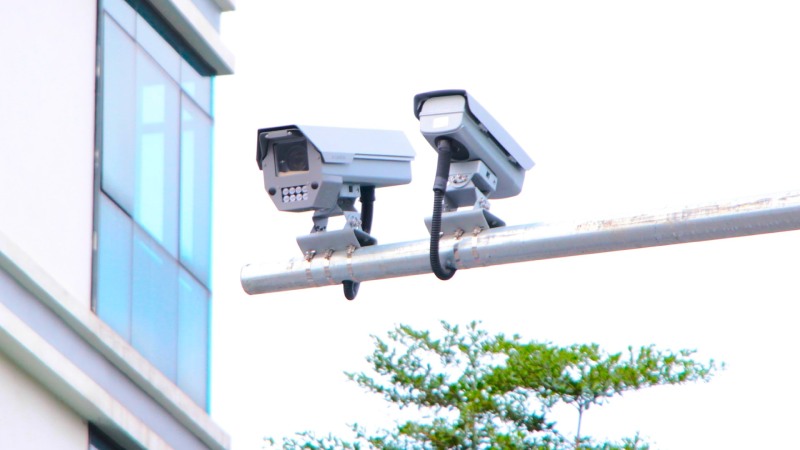
Close-up view of AI camera at the Tay Son - O Cho Dua - Hoang Cau intersection, Hanoi - Photo: Government Policy Development
The overall configuration of this system not only includes surveillance cameras, but also a complete technological infrastructure including processing, storage, transmission, analysis and centralized operation equipment.
ANPR license plate recognition technology
AI technology detects violations
Edge Computing technology
Data storage and security technology
Connection and data transmission technology
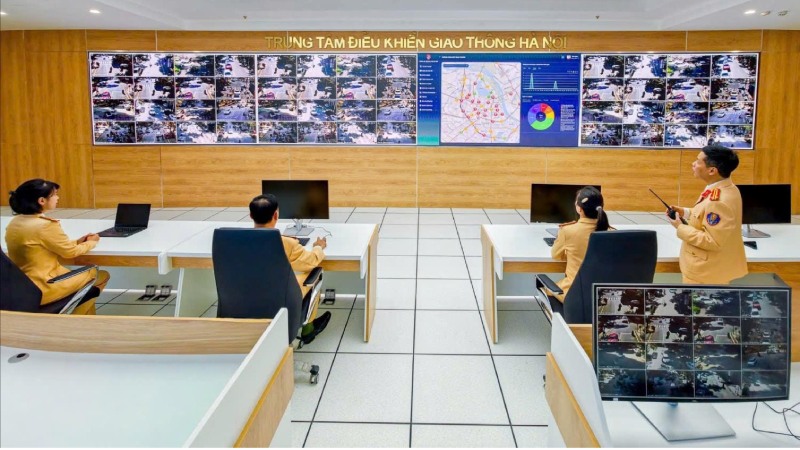
Hanoi Traffic Control Center - Photo: Government Policy Development
The cold fine mechanism is stipulated in many legal documents, including:
Step 1: Detect traffic violations
Traffic police or automatic monitoring systems will detect and record violations such as: Running red lights, driving in the wrong lane, stopping and parking in violation of regulations, driving over the speed limit, not obeying traffic signals...
Data sources can come from: Surveillance cameras of police agencies or ITS centers, devices of other organizations and individuals or information sources on media or feedback from people.
Step 2: Check, analyze and identify violations
Authorities perform:
Principle of decentralization of handling:
Step 3: Notify the violator
After verifying the behavior, the violation notice will be sent to the vehicle owner in the following forms:
Step 4: Coordinate to resolve and handle violations
When the violator or vehicle owner comes to work:
A competent officer (Traffic Police, Head of Commune/District Police) shall draw up a record of administrative violations within 03 days from the date the violator is identified.
Step 5: Updating the handling results and closing the file
After handling:
The Commune/District Police must notify the handling results to the agency where the violation was detected.
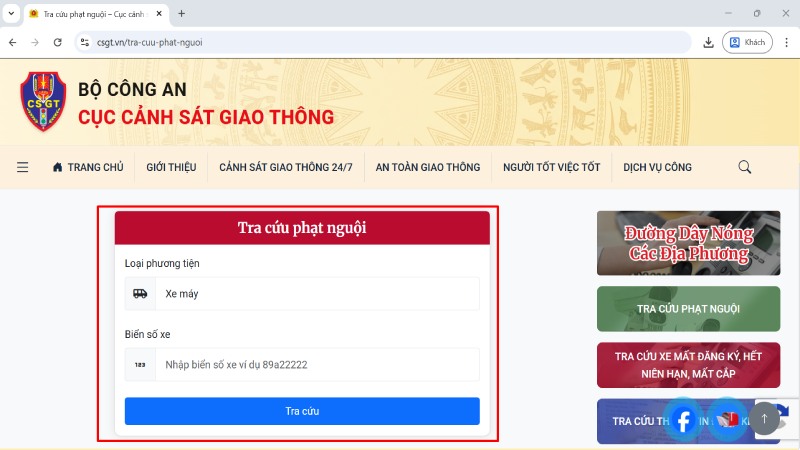
https://www.csgt.vn/tra-cuu-phat-nguoi
KPS deploys solutions on an open platform, allowing for flexible integration with various traffic monitoring and control systems.
Our traffic camera systems can connect with VMS platforms and control centers such as Genetec, and are compatible with devices from leading camera and security manufacturers such as Bosch, CNB, and i-PRO. This ensures scalability, data synchronization, and no vendor lock-in.
With over 16 years of development and more than 800 implemented projects, KPS possesses practical experience in deploying large-scale monitoring systems requiring high accuracy and continuous operation.
Our project portfolio spans multiple sectors:
Our multidisciplinary experience allows KPS to thoroughly understand real-world data, operational, and system integration challenges – thereby optimizing the deployment of traffic cameras in complex traffic environments.
Beyond simply supplying cameras, KPS focuses on building a complete system:
→ This is the core element that makes the traffic camera system effective in practice, rather than just deploying equipment.
KPS is ready to partner with management agencies and implementation units in building an effective, accurate, and suitable traffic camera system for each traffic model.
Contact KPS today for consultation on a solution tailored to your project's scale and requirements.

Other news

Signify and KPS sign strategic partnership agreement.
Signify and KPS have signed a strategic partnership to promote smart, energy-efficient lighting solutions for buildings in Vietnam.
View detail

From APEC 2017 Da Nang to APEC 2027 Phu Quoc: From traditional security solutions to smart IOCs.
From APEC 2017 security monitoring solutions to a smart IOC model for APEC 2027 in Phu Quoc.
View detail

Team Building KPS 2026 | Da Nang - Hoi An - Hue
KPS 2026 Team Building journey in Da Nang - Hoi An - Hue, where teams bond, recharge, and spread sustainable values.
View detail

Optimizing air conditioning based on room conditions in hotels and resorts.
Why do 20-30% of hotel rooms still have their air conditioning running even when there are no guests?
View detail

Energy-saving solutions for hotels and resorts - without compromising the experience.
Consulting and implementing EMS systems for hotels - reducing electricity costs, smarter operation - without compromising customer experience.
View detail

Energy Management System (EMS): Cost and Operation Optimization
EMS solutions help businesses monitor, analyze, and optimize energy in real time, saving 10-30% on electricity costs.
View detail
ABOUT KPS


Regulations and policies
Warranty and return policy Delivery, payment, and feedback Giấy phép kinh doanhContact Information
HO CHI MINH OFFICE
10–12 Dong Van Cong Street, Cat Lai Ward, Ho Chi Minh City.
+842839976099 / 903 709 019
info@kps.com.vn
www.kps.com.vn
Work time
Monday – Friday : 8:00 AM - 17:30 PM
Saturday - Sunday: Off
HA NOI OFFICE
22 Alley 168 Nguyen Xien, Khuong Dinh Ward, Hanoi City
+84 903 709 019
kpshn@kps.com.vn
www.kps.com.vn
Work time
Monday – Friday: 8:00 AM - 17:30 PM
Saturday - Sunday: Off
DA NANG OFFICE
490 Nguyen Tri Phuong, Hoa Cuong Ward, Da Nang City
+84 903 709 019
kpsdn@kps.com.vn
www.kps.com.vn
Work time
Monday – Friday: 8:00 AM - 17:30 PM
Saturday - Sunday: Off
CAN THO OFFICE
11/11 Tran Binh Trong, Ninh Kieu Ward, Ninh Kieu District, Can Tho City.
+84 090 709 019
kpsct@kps.com.vn
www.kps.com.vn
Work time
Monday – Friday: 8:00 AM - 17:30 PM
Saturday - Sunday: Off
SERVICE CENTER - WAREHOUSE
10–12 Dong Van Cong Street, Cat Lai Ward, Ho Chi Minh City.
+ 84 28 3997 0609
baohanh@kps.com.vn
www.kps.com.vn
Work time
Monday – Friday: 8:00 AM - 17:30 PM
Saturday - Sunday: Off
2010 © Bản quyền thuộc KPS
Online: 34 | Visitors Counter: 17850472
About | Recruitment | News | Contact Us


