


info@kps.com.vn
+84 903 709 019
In the context where modern buildings increasingly demand intelligence, high integration capability, and sustainable operational efficiency, traditional electrical systems no longer meet the requirements for flexibility, scalability, and energy optimization. Instead, automation platforms based on open international standards are becoming the inevitable choice for high-end residences, commercial buildings, and large-scale infrastructure projects.
The article below provides a comprehensive analysis of the ABB i-bus KNX platform – from technology standards, device architecture, software tools, and integration capabilities to typical real-world applications in modern buildings – helping investors and system integrators gain a complete perspective before selecting a solution.
KNX is an international open standard for smart homes and buildings, compliant with EN 50090 and ISO / IEC 14543. It was formed through the unification of EHS, BatiBUS, and EIB (Instabus) standards and is managed by the KNX Association. KNX is widely adopted worldwide and serves as the standard platform for building automation systems, from lighting and HVAC to shading, security, and energy management.
The ABB i-bus KNX system is an integrated management platform that enables comprehensive control of lighting, heating, ventilation, air conditioning (HVAC), security systems, and energy management. By utilizing data collected from a dense network of sensors, this technology can reduce energy consumption by up to 30% compared to traditional electrical installations without automation capabilities.
In conventional electrical systems, changing control functions often requires complex physical interventions such as wall demolition or rewiring. With KNX architecture, however, functions are defined via software, providing maximum flexibility and allowing the system to adapt to changes in building usage throughout its lifecycle.
The ABB i-bus KNX ecosystem is built on a modular – distributed – and scalable architecture, where each device performs a specific role while remaining tightly connected via the KNX bus. It can be divided into five main groups as follows:
KNX Power Supplies:
Provide a stable 29V DC voltage and integrate a choke to prevent bus signal suppression by the power supply.
IP Routers & Interfaces:
Enable integration of the KNX network into the building’s Ethernet infrastructure. This not only increases data transmission speed between line segments but also enables remote control via the Internet and integration with large-scale Building Management Systems (BMS).
Line Couplers:
Connect different KNX bus lines while maintaining electrical isolation and filtering telegrams to reduce network load.
Presence & Motion Detectors:
Capable of detecting even the smallest movements of seated occupants, maintaining optimal lighting and temperature levels and automatically switching off when rooms are unoccupied.
Weather Sensors:
Measure light intensity, wind speed, temperature, and rainfall. This data is used to intelligently control shading systems, protecting buildings from extreme weather conditions and optimizing natural thermal comfort.
Touch Control Interfaces (ABB RoomTouch & SmartTouch):
High-resolution touchscreens that allow users to control all room functions from a single point through an intuitive and elegant interface.
Switch Actuators (On/Off Loads):
Control lighting, power sockets, pumps, and electrical equipment.
Dimmer Actuators:
Adjust brightness levels of LED and halogen lighting.
Shading Actuators:
Precisely control curtain positions and louver angles, maximizing natural daylight without glare.
DALI Lighting Controllers (DALI Gateways):
Connect KNX systems to the professional DALI lighting standard, allowing control of up to 64 luminaires per DALI channel and supporting advanced features such as Tunable White and Human Centric Lighting (HCL) to align lighting with human circadian rhythms.
Fan Coil Controllers:
Manage heat exchangers, fans, and valves within air conditioning systems, ensuring maximum comfort with minimal energy consumption.
Air Quality Sensors:
Monitor CO₂ concentration, humidity, and temperature to automatically adjust ventilation systems, safeguarding occupant health and alertness.
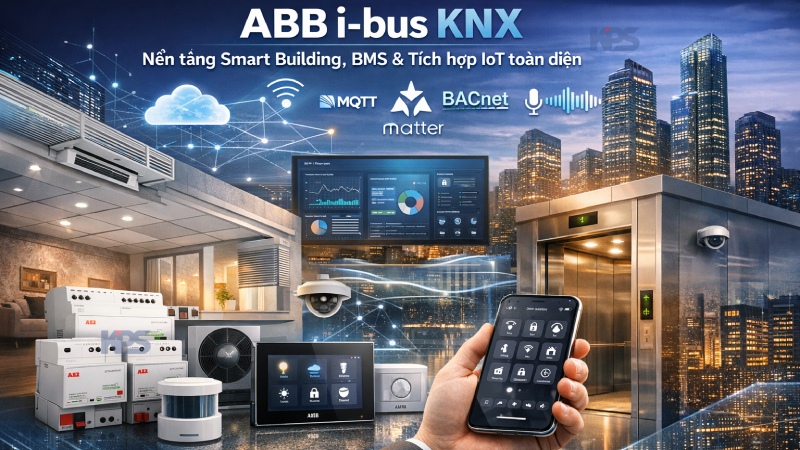
One of the standout advantages of ABB i-bus KNX lies in its software support. ETS tools are the key factor determining whether a system is truly “intelligent,” operates reliably over the long term, and remains easy to expand, maintain, and optimize for energy efficiency.
ETS (Engineering Tool Software) is the dedicated software developed by the KNX Association for designing, configuring, programming, and diagnosing KNX-based smart home and building systems. ETS enables integration of thousands of certified products from over 500 manufacturers, allowing centralized management of lighting, shading, security, and more within a single interface.
Key Features of ETS:
For medium to large-scale ABB i-bus KNX systems, challenges extend beyond design and ETS programming to operation, diagnostics, and lifecycle maintenance. To address this, ABB developed the i-bus Tool – a free, specialized software for KNX integrators.
ABB i-bus Tool is a commissioning and service tool that allows:
Its core distinction lies in operating alongside ETS, serving the operation, maintenance, and troubleshooting phases rather than system logic programming.
In medium to large-scale buildings such as offices, hotels, hospitals, and mixed-use complexes, the Building Management System (BMS) functions as the central monitoring and optimization platform. ABB i-bus KNX, meanwhile, serves as the field-level control layer, offering high stability and flexible scalability.
KNX easily integrates with standards such as BACnet and Modbus, which are widely used in industrial-scale HVAC and energy management systems. This integration allows KNX to act as an extension of the centralized BMS, delivering transparency from endpoint devices to the control center.
KNX: Distributed field control, responsible for:
BMS: Centralized management, responsible for:
In the IoT era, smart buildings extend beyond simple on/off control to connectivity, data collection, analysis, and contextual response. With its open standard foundation and distributed architecture, ABB KNX serves as an ideal physical control layer for modern IoT platforms.
Methods for Integrating ABB i-bus KNX with IoT:
Solutions such as Matter-to-KNX gateways allow traditional KNX devices to appear as native entities within modern IoT control applications. This enables users to combine the absolute stability of wired KNX systems with the flexibility of wireless Matter devices within a unified management interface.
As voice control becomes a natural interaction layer in smart buildings, it is no longer merely a demonstrative feature but a critical user interface layer in modern building architecture.
With ABB i-bus KNX, voice control does not operate independently but is built on a robust wired control foundation, ensuring precision, security, and long-term scalability.
Integration Methods:
By combining the ABB i-bus® KNX automation platform with the ABB Welcome IP video door communication system, modern buildings can deploy fully automated intercom – door unlocking – elevator calling solutions. Residents or office staff can welcome guests remotely without visiting the lobby, a hallmark feature of next-generation Smart Buildings, especially in luxury residential towers, Grade A offices, and mixed-use developments.
The elevator calling solution is built on an IP – KNX – Elevator Control integration model, consisting of:
All communication occurs over a secure IP network, ensuring stability and scalability for large buildings.
Step 1: Guest Communication & Verification
When a guest presses the call button at the lobby Outdoor Station:
This enables accurate guest verification before granting access.
Step 2: Door Unlocking & Automatic Elevator Call
After verification:
The guest does not need to perform any additional actions; the elevator arrives automatically.
Step 3: Intelligent Floor Authorization
Once the guest enters the elevator:
KPS is a leading provider and distributor of integrated security solutions in Vietnam. With over 15 years of experience and a diverse product ecosystem, KPS is the official distributor and partner of global technology brands such as i-PRO, BOSCH, CNB, Legrand, Genetec, MAG, ABB, GST, Optex, Tycon, Simplex, Janus Fire…
With a total-solution development approach, KPS partners with investors, consultants, and contractors throughout the project lifecycle – from solution consulting and technical design to equipment supply, system integration, and operational support.
KPS solutions focus on long-term stability, flexible scalability, energy optimization, and enhanced user experience, meeting the stringent technical standards of modern buildings.
In the Smart Building domain, KPS distributes and deploys trusted brands such as ABB, Legrand, and CNB, delivering core solutions including:
With a team of highly experienced engineers and deep expertise in international standards, KPS is committed to delivering the most suitable solutions for every project type – from luxury residences and hotels to offices and large-scale infrastructure developments.
KPS – A trusted partner in shaping intelligent, secure, and sustainable spaces.
Other news

Signify and KPS sign strategic partnership agreement.
Signify and KPS have signed a strategic partnership to promote smart, energy-efficient lighting solutions for buildings in Vietnam.
View detail

From APEC 2017 Da Nang to APEC 2027 Phu Quoc: From traditional security solutions to smart IOCs.
From APEC 2017 security monitoring solutions to a smart IOC model for APEC 2027 in Phu Quoc.
View detail

Team Building KPS 2026 | Da Nang - Hoi An - Hue
KPS 2026 Team Building journey in Da Nang - Hoi An - Hue, where teams bond, recharge, and spread sustainable values.
View detail

Optimizing air conditioning based on room conditions in hotels and resorts.
Why do 20-30% of hotel rooms still have their air conditioning running even when there are no guests?
View detail

Energy-saving solutions for hotels and resorts - without compromising the experience.
Consulting and implementing EMS systems for hotels - reducing electricity costs, smarter operation - without compromising customer experience.
View detail

Energy Management System (EMS): Cost and Operation Optimization
EMS solutions help businesses monitor, analyze, and optimize energy in real time, saving 10-30% on electricity costs.
View detail
ABOUT KPS


Regulations and policies
Warranty and return policy Delivery, payment, and feedback Giấy phép kinh doanhContact Information
HO CHI MINH OFFICE
10–12 Dong Van Cong Street, Cat Lai Ward, Ho Chi Minh City.
+842839976099 / 903 709 019
info@kps.com.vn
www.kps.com.vn
Work time
Monday – Friday : 8:00 AM - 17:30 PM
Saturday - Sunday: Off
HA NOI OFFICE
22 Alley 168 Nguyen Xien, Khuong Dinh Ward, Hanoi City
+84 903 709 019
kpshn@kps.com.vn
www.kps.com.vn
Work time
Monday – Friday: 8:00 AM - 17:30 PM
Saturday - Sunday: Off
DA NANG OFFICE
490 Nguyen Tri Phuong, Hoa Cuong Ward, Da Nang City
+84 903 709 019
kpsdn@kps.com.vn
www.kps.com.vn
Work time
Monday – Friday: 8:00 AM - 17:30 PM
Saturday - Sunday: Off
CAN THO OFFICE
11/11 Tran Binh Trong, Ninh Kieu Ward, Ninh Kieu District, Can Tho City.
+84 090 709 019
kpsct@kps.com.vn
www.kps.com.vn
Work time
Monday – Friday: 8:00 AM - 17:30 PM
Saturday - Sunday: Off
SERVICE CENTER - WAREHOUSE
10–12 Dong Van Cong Street, Cat Lai Ward, Ho Chi Minh City.
+ 84 28 3997 0609
baohanh@kps.com.vn
www.kps.com.vn
Work time
Monday – Friday: 8:00 AM - 17:30 PM
Saturday - Sunday: Off
2010 © Bản quyền thuộc KPS
Online: 71 | Visitors Counter: 18513563
About | Recruitment | News | Contact Us


